
Journal Article10.1103/physrevd.108.046015
Top down approach to topological duality defects
Jonathan J. Heckman,Max Hübner,Ethan Torres,Xingyang Yu,Hao Y. Zhang +4 more
TL;DR: Top-down construction of topological duality defects in quantum field theories with duality symmetry leads to noninvertible symmetries and 5D topological field theories.
read more
Abstract: Topological duality defects arise as codimension one generalized symmetry operators in quantum field theories (QFTs) with a duality symmetry. Recent investigations have shown that in the case of 4D $\mathcal{N}=4$ Super Yang-Mills (SYM) theory, an appropriate choice of (complexified) gauge coupling and global form of the gauge group can lead to a rather rich fusion algebra for the associated defects, leading to examples of noninvertible symmetries. In this work we present a top down construction of these duality defects which generalizes to QFTs with lower supersymmetry, where other 0-form symmetries are often present. We realize the QFTs of interest via D3-branes probing $X$ a Calabi-Yau threefold cone with an isolated singularity at the tip of the cone. The IIB duality group descends to dualities of the 4D worldvolume theory. Nontrivial codimension one topological interfaces arise from configurations of 7-branes ``at infinity'' which implement a suitable $SL(2,\mathbb{Z})$ transformation when they are crossed. Reduction on the boundary topology $\ensuremath{\partial}X$ results in a 5D symmetry topological field theory. Different realizations of duality defects, such as the gauging of 1-form symmetries with certain mixed anomalies and half-space gauging constructions, simply amount to distinct choices of where to place the branch cuts in the 5D bulk.
read more
Chat with Paper
AI Agents for this Paper
Find similar papers on Google Scholar, PubMed and Arxiv
Write a critical review of this paper
Analyze citations of this paper to find unaddressed research gaps
Figures
![TABLE I. Elliptic data of 7-brane profiles with constant axiodilaton τ. Their group of lines is isomorphic to cokerðρ − 1Þ which is isomorphic to Zk except for fiber type I 0; II; II . The label m of these lines is determined from the refined self-linking numbers m=2k which gives the spin of nontrivial lines. The refined self-linking numbers compute via the Gordon-Litherland approach laid out in [70] employing the divisors (Kodaira thimbles) computed in [151] or alternatively via the quadratic refinement laid out in [34] and the linking number computations in [48]. Note in particular that in all cases gcdðk;mÞ ¼ 1 and mk ∈ 2Z.](/figures/tablei-1-kq3jetaep1dz.png)
TABLE I. Elliptic data of 7-brane profiles with constant axiodilaton τ. Their group of lines is isomorphic to cokerðρ − 1Þ which is isomorphic to Zk except for fiber type I 0; II; II . The label m of these lines is determined from the refined self-linking numbers m=2k which gives the spin of nontrivial lines. The refined self-linking numbers compute via the Gordon-Litherland approach laid out in [70] employing the divisors (Kodaira thimbles) computed in [151] or alternatively via the quadratic refinement laid out in [34] and the linking number computations in [48]. Note in particular that in all cases gcdðk;mÞ ¼ 1 and mk ∈ 2Z. 
FIG. 3. Case (1). With 7-branes wrapped on M3 × ∂X, we sketch the plane R≥0 × R⊥. The topological boundary conditions jP1; D1i are the monodromy transform of the boundary conditions jP2; D2i and result from stacking the branch cut with the asymptotic boundary. The branch cut is supported on H← × ∂X and runs parallel to the D3-branes. Conventions are such that the monodromy matrix ρ acts by crossing the branch cut top to bottom. 
FIG. 12. The operator O½q;p is defined on M04 in the 5D bulk which is homotopic to either boundary. The operator acts on the topological boundary condition jP;Di by colliding M04 with the corresponding boundary component. 
FIG. 17. Operators O½q;p for 4D N ¼ 4 suð2Þ gauge theory. 
TABLE III. Fields in the 5D TFT and their corresponding global symmetries in 4D SCFTs. The charged operators composed of various types of branes are also presented. σ and γ denote nontorsional and torsional cycles, respectively. We use an upper index for the one cycles and a lower index for the three cycles. 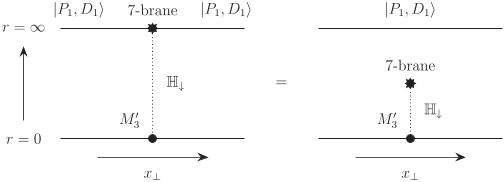
FIG. 4. Case (2). With 7-branes wrapped on M3 × ∂X, we sketch the plane R≥0 × R⊥. There is a single set of boundary conditions jP1; D1i. The branch cut is supported on H↓ × ∂X and runs perpendicular to the D3-branes. Conventions are such that the monodromy matrix ρ acts by crossing the branch cut left to right.
![TABLE I. Elliptic data of 7-brane profiles with constant axiodilaton τ. Their group of lines is isomorphic to cokerðρ − 1Þ which is isomorphic to Zk except for fiber type I 0; II; II . The label m of these lines is determined from the refined self-linking numbers m=2k which gives the spin of nontrivial lines. The refined self-linking numbers compute via the Gordon-Litherland approach laid out in [70] employing the divisors (Kodaira thimbles) computed in [151] or alternatively via the quadratic refinement laid out in [34] and the linking number computations in [48]. Note in particular that in all cases gcdðk;mÞ ¼ 1 and mk ∈ 2Z.](/figures/tablei-1-kq3jetaep1dz.webp)


Citations
ICTP lectures on (non-)invertible generalized symmetries
TL;DR: This lecture series introduces generalized symmetries in Quantum Field Theory, focusing on non-invertible symmetries, which are identified with topological defects, and their action on higher-charges, including higher-representations and Symmetry Topological Field Theory.
80
Lectures on generalized symmetries
Lakshya Bhardwaj,Lea E. Bottini,Ludovic Fraser-Taliente,Liam Alexander Henry Gladden,D. Gould,Arthur Platschorre,Hannah Tillim +6 more
TL;DR: This set of lecture notes explores generalized global symmetries in quantum field theory, covering higher-form symmetries, 't Hooft anomalies, gauging, and spontaneous symmetry breaking, with applications to holography and string theory.
74
Symmetry TFTs and anomalies of non-invertible symmetries
Justin Kaidi,Emily Nardoni,Gabi Zafrir,Yunqin Zheng +3 more
TL;DR: The linking invariants in a non-invertible TQFT known as the Symmetry TFT (SymTFT) can be used as a diagnostic for ’t Hooft anomalies of non-invertible symmetries.
Remarks on boundaries, anomalies, and noninvertible symmetries
Yichul Choi,Brandon C. Rayhaun,Yaman Sanghavi,Shu-Heng Shao +3 more
TL;DR: The role of boundary conditions in noninvertible symmetries and their relation to anomalies and RG flows is studied. Different categories of symmetric boundary conditions are found.
Subsystem Non-Invertible Symmetry Operators and Defects
19 Apr 2023
TL;DR: In this paper , a subsystem Kramers-Wannier duality transformation is introduced, which generalizes the ordinary Kramer Wannier transformation to the subsystem kramers Wanniers transformation.
References
Fusion Rules and Modular Transformations in 2D Conformal Field Theory
TL;DR: In this paper, the authors studied conformal field theories with a finite number of primary fields with respect to some chiral algebra and showed that the fusion rules are completely determined by the behavior of the characters under the modular group.
1.9K
Generalized Global Symmetries
TL;DR: A q-form global symmetry is a global symmetry for which the charged operators are of space-time dimension q; e.g. strings, membranes, etc. as discussed by the authors, which leads to Ward identities and hence to selection rules on amplitudes.
AdS3 black holes and a stringy exclusion principle
Juan Maldacena,Andrew Strominger +1 more
TL;DR: In this article, the duality relating near-horizon microstates of black holes obtained as orbifolds of a subset of AdS3 to the states of a conformal field theory is analyzed in detail.
1.1K
Reading between the lines of four-dimensional gauge theories
TL;DR: In this paper, the authors show that the existence of these distinct theories clarifies a number of issues in electric/magnetic dualities of supersymmetric gauge theories, both for the conformal N = 4 theories and for the low-energy duality of N = 1 theories.
Brane dimers and quiver gauge theories
TL;DR: In this paper, a brane tiling is constructed for non-compact 3-dimensional toric Calabi-Yau manifolds, which can be represented as a periodic tiling of the plane.
620