
Self-Reported Population Health: An International Perspective based on EQ-5D
933
About: This article is published in Value in Health. The article was published on 01 Nov 2013. and is currently open access. The article focuses on the topics: Quality of life (healthcare) & Population health.
read more
Chat with Paper
AI Agents for this Paper
Find similar papers on Google Scholar, PubMed and Arxiv
Write a critical review of this paper
Analyze citations of this paper to find unaddressed research gaps
Figures
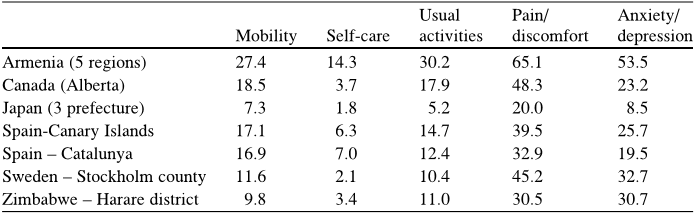
Table 3.4 Reported problems by five dimensions (% of any problem) – regional surveys 
Fig. 3.11 Reported problems with anxiety/depression (% of any problem) 
Fig. 3.4 EQ VAS ratings by age group (countries with ‘lower values’) 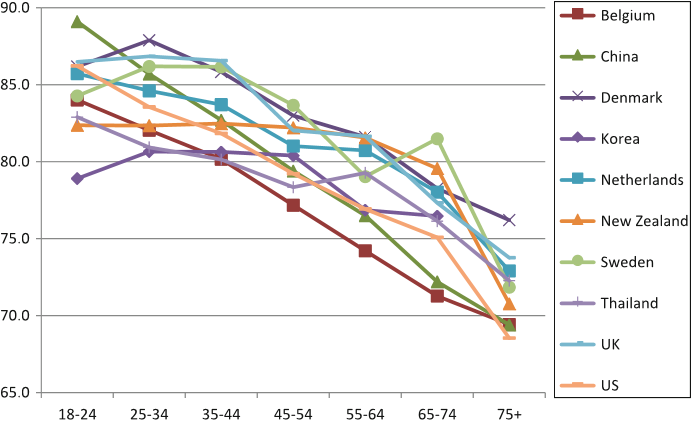
Fig. 3.3 EQ VAS ratings by age group (countries with ‘upper values’) 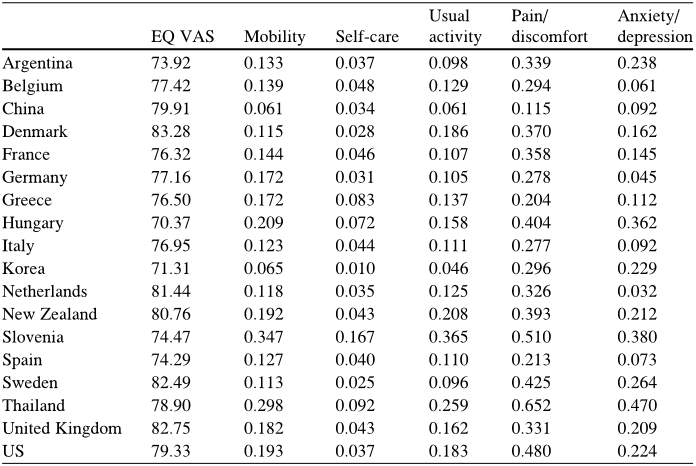
Table 4.1 Self-reported EQ-5D results after age standardization (mean VAS and proportions of any problem) 
Fig. 3.5 EQ-5D profile of the population (% reporting any problem)


Citations
Nivolumab in patients with metastatic DNA mismatch repair-deficient or microsatellite instability-high colorectal cancer (CheckMate 142): an open-label, multicentre, phase 2 study
Michael J. Overman,Ray McDermott,Joseph Leach,Sara Lonardi,Heinz-Josef Lenz,Michael A. Morse,Jayesh Desai,Andrew G. Hill,Michael D. Axelson,Rebecca A. Moss,Monica V. Goldberg,Z. Alexander Cao,Jean Marie Ledeine,G. Maglinte,Scott Kopetz,Thierry André +15 more
TL;DR: Nivolumab provided durable responses and disease control in pre-treated patients with dMMR/MSI-H metastatic colorectal cancer, and could be a new treatment option for these patients.
Fatigue and cognitive impairment in Post-COVID-19 Syndrome: A systematic review and meta-analysis
01 Mar 2022
TL;DR: In this paper , a meta-analysis of proportions was conducted to pool Freeman-Tukey double arcsine transformed proportions using the random-effects restricted maximum-likelihood model to quantify the proportion of individuals experiencing fatigue and cognitive impairment 12 or more weeks following COVID-19 diagnosis.
1.1K
Postoperative pain and quality of life after lobectomy via video-assisted thoracoscopic surgery or anterolateral thoracotomy for early stage lung cancer: a randomised controlled trial
Morten Bendixen,Ole Dan Jørgensen,Christian Kronborg,Claus Andersen,Peter B. Licht,Peter B. Licht +5 more
TL;DR: Postoperative pain and quality of life were investigated in a randomised trial of patients with early-stage non-small-cell lung cancer undergoing VATS versus open surgery, suggesting that VATS should be the preferred surgical approach for lobectomy in stage I non- Small cell lung cancer.
979
Effect of Continuous Glucose Monitoring on Glycemic Control in Adults With Type 1 Diabetes Using Insulin Injections: The DIAMOND Randomized Clinical Trial.
Roy W. Beck,Tonya D Riddlesworth,Katrina J. Ruedy,Andrew J. Ahmann,Richard M. Bergenstal,Stacie Haller,Craig Kollman,Davida F. Kruger,Janet B. McGill,William H. Polonsky,Elena Toschi,Howard Wolpert,David Price +12 more
TL;DR: Among adults with type 1 diabetes who used multiple daily insulin injections, the use of CGM compared with usual care resulted in a greater decrease in HbA1c level during 24 weeks.
References
Modeling Valuations for EuroQol Health States
TL;DR: The model presented in this article appears to predict the values of the states for which there are direct observations and, thus, can be used to interpolate values for theStates for which no direct observations exist.
4.7K
Measurement of health state utilities for economic appraisal.
TL;DR: A framework for economic appraisal is presented displaying the various components that must be measured, and showing how the three forms of analysis relate to the framework and to each other.
2.3K
On the measurement of inequalities in health
TL;DR: It is suggested that only two methods--the slope index of inequality and the concentration index--are likely to present an accurate picture of socioeconomic inequalities in health.
1.8K
Socioeconomic inequalities in health: Measurement, computation, and statistical inference
TL;DR: In this article, the relationship between two widely used indices of health inequality and explain why these are superior to others indices used in the literature is explained and the role that demographic standardization plays in the analysis of socioeconomic inequalities in health.
1.4K