
Journal Article10.2352/ei.2024.36.4.mwsf-337
Secure Payload Scaling For Source Adaptive Payload Allocation
Eli Dworetzky,Edgar Kaziakhmedov,Jessica Fridrich +2 more
TL;DR: Secure payload scaling for source adaptive payload allocation exhibits super-square root secure payload scaling for tens of thousands of uses of the stego channel.
read more
Abstract: Assuming that Alice commits to an embedding method and the Warden to a detector, we study how much information Alice can communicate at a constant level of statistical detectability over potentially infinitely many uses of the stego channel.When Alice is allowed to allocate her payload across multiple cover objects, we find that certain payload allocation strategies that are informed by a steganography detector exhibit super-square root secure payload (scaling exponent 0.85) for at least tens of thousands of uses of the stego channel.We analyze our experiments with a source model of soft outputs of the detector across images and show how the model determines the scaling of the secure payload. Response curveWe use C to denote the maximum embedding capacity of a cover image X ∈ X .For a ternary embedding scheme in the spatial domain, C ≤ log 2 3 bits per pixel (bpp).Since most steganographic schemes avoid making changes to saturated pixels, the capacity can be strictly smaller than log 2 3.
read more
Chat with Paper
AI Agents for this Paper
Find similar papers on Google Scholar, PubMed and Arxiv
Write a critical review of this paper
Analyze citations of this paper to find unaddressed research gaps
Figures

Figure 4. PE vs. bag size n when detecting real stego bags. The payloads embedded are the secure payloads Pδ(n) determined from the simulated experiments. Each curve corresponds to a particular case of Alice’s SID & spreader and Warden’s SID & pooler. We hypothesize that this figure’s legend is one of the world’s largest. 
Figure 3. Log-log plot of secure payload vs. bag size n for the greedy and SLS payload allocation strategies with two poolers. Embedding algorithm HILL, PE = 0.2, SRNet trained on Split 1, B4 on Split 2, evaluated on Split 3. Left: Alice uses B4 and Warden SRNet. Right: Alice SRNet and Warden B4. 
Figure 5. PE vs. bag size n when detecting real stego bags for a PLS of the form P (n) = 0.5nγ . Each curve corresponds to a different case of scaling exponent γ = 0.7,0.8,0.9 and mismatched SIDs. For blue curves, Alice uses B4 and SLS. Warden uses SRNet and πcorr1. For red curves, Alice uses SRNet and greedy sender. Warden uses B4 and πcorr2. 
Figure 6. Left: Plot of the PDF F of s2(C) across Split 3. Right: The corresponding Log-log plot of the CDF with a best fit line of slope β ≈ 0.22. 
Figure 1. Log-log plot of secure payload vs. bag size n for various payload allocation strategies and poolers. For every n, the Warden’s pooler π achieves constant detectability PE = 0.2. Left: SID SRNet. Right: SID B4. 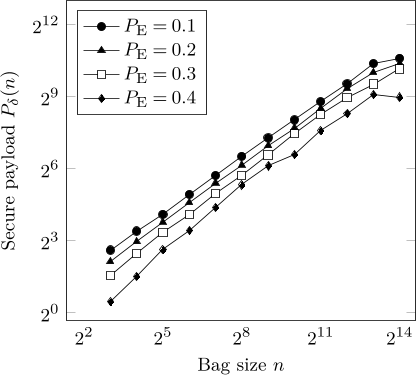
Figure 2. Log-log plot of secure payload vs. bag size n for a range of fixed detectability levels PE. Alice uses greedy sender and embedding algorithm HILL. Warden uses πcorr2. Both use the same SRNet as their SID.


References
•Proceedings Article
EfficientNet: Rethinking Model Scaling for Convolutional Neural Networks
Mingxing Tan,Quoc V. Le +1 more
- 24 May 2019
TL;DR: EfficientNet-B7 as discussed by the authors proposes a new scaling method that uniformly scales all dimensions of depth/width/resolution using a simple yet highly effective compound coefficient, which achieves state-of-the-art accuracy on ImageNet, while being 8.4x smaller and 6.1x faster on inference.
•Book
Scientific Charge-Coupled Devices
James R. Janesick,Tom Elliott,Stewart A. Collins,Morley M. Blouke,Jack W. Freeman +4 more
- 01 Jan 2001
TL;DR: In this article, the spectral response, charge collection, charge transfer, and readout noise properties of charge-coupled devices have been investigated, and their potential for future improvement is discussed.
1.4K
Break our steganographic system: the ins and outs of organizing BOSS
Patrick Bas,Tomas Filler,Tomáš Pevný +2 more
- 18 May 2011
TL;DR: This paper summarizes the first international challenge on steganalysis called BOSS (an acronym for Break The authors' Steganographic System), explaining the motivations behind the organization of the contest, its rules together with reasons for them, and the steganographic algorithm developed for the contest.
Deep Residual Network for Steganalysis of Digital Images
TL;DR: A deep residual architecture designed to minimize the use of heuristics and externally enforced elements that is universal in the sense that it provides state-of-the-art detection accuracy for both spatial-domain and JPEG steganography.
832
A new cost function for spatial image steganography
Bin Li,Ming Wang,Jiwu Huang,Xiaolong Li +3 more
- 01 Oct 2014
TL;DR: Experiments show that the steganographic method with the proposed cost function makes the embedding changes more concentrated in texture regions, and thus achieves a better performance on resisting the state-of-the-art steganalysis over prior works, including HUGO, WOW, and S-UNIWARD.
669