
Peer Review10.5194/essd-2023-486-ac4
Reply on RC2
Laura Schild
- 28 May 2024
TL;DR: Improved quantitative vegetation cover reconstruction from a global sedimentary pollen data set using REVEALS
read more
Abstract: <strong class="journal-contentHeaderColor">Abstract.</strong> With rapid anthropogenic climate change future vegetation trajectories are uncertain. Climate-vegetation models can be useful for predictions but need extensive data on past vegetation for validation and improving systemic understanding. Even though pollen data provide a great source of this information, the data is compositionally biased due to differences in taxon-specific relative pollen productivity (RPP) and dispersal. Here we reconstructed quantitative regional vegetation cover from a global sedimentary pollen data set for the last 50 ka using the REVEALS model to correct for taxon- and basin-specific biases. In a first reconstruction, we used previously published, continental RPP values. For a second reconstruction, we statistically optimized RPP values for common taxa with the goal of improving the fit of reconstructed forest cover from modern pollen samples with remote sensing forest cover. The data sets include taxonomic compositions as well as reconstructed forest cover for each original pollen sample. Relative pollen sources areas were also calculated and are included in the data set of the original REVEALS run. Additional metadata includes modeled ages, age model sources, basin locations, types and sizes. The improvements in forest cover reconstructions with the REVEALS reconstruction using original/optimized parameters range from 1/0 % (Australia and Oceania/Australia and Oceania) to 58/65 % (Europe/North America) relative to the mean absolute error (MAE) in the pollen-based reconstruction. Optimizations were considerably more successful in reducing MAE when more records and RPP estimates were available. The optimizations were purely statistical and only partly ecologically informed and should, therefore, be used with caution depending on the study matter. This improved quantitative reconstruction of vegetation cover is invaluable for the investigation of past vegetation dynamics and modern model validation. By collecting more RPP estimates for taxa in the Southern Hemisphere and adding more records to existing pollen data syntheses, reconstructions may be improved even further. Both reconstructions are freely available on PANGAEA (see Data availability section).
read more
Chat with Paper
AI Agents for this Paper
Find similar papers on Google Scholar, PubMed and Arxiv
Write a critical review of this paper
Analyze citations of this paper to find unaddressed research gaps
Figures
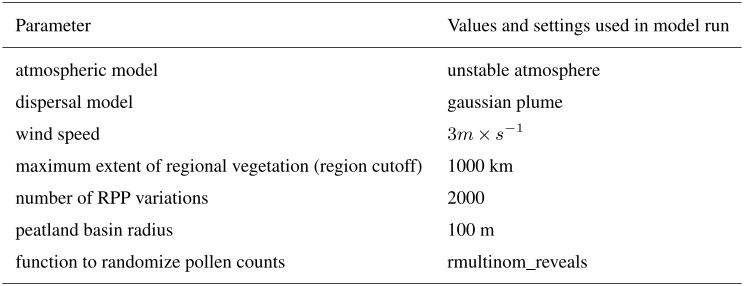
Table 2. Static model parameters for REVEALS runs using REVEALSinR (Theuerkauf et al., 2016). 
Figure 3. Percentage of pollen counts per continent for which RPP estimates are available. A higher percentage of pollen counts has RPP information in the Northern Hemisphere compared to the continents of the Southern Hemisphere. 
Figure 7. Average continental taxonomic coverages per reconstruction for the 8 most common taxa per continent. Compositional differences are more pronounced in the Northern Hemisphere due to the availability of more RPP values. 
Figure 11. Bar graph of MAE improvement relative to the MAE of the pollen-based reconstruction per continent and REVEALS reconstruction. The absolute MAE reduction is shown in the text labels. Except for Australia and Oceania, the REVEALS reconstruction with optimized RPP values achieves higher improvements. Improvements are generally higher in the Northern Hemisphere. 
Figure 6. Dumbbell graph illustrating original and optimized RPP values per continent and taxon. Arboreal taxa such as Pinus, Picea, Quercus have increases that are especially large. 
Figure 10. Remote sensing forest cover (LANDSAT) and reconstructed forest cover from Pollen, REVEALS with original RPP values, and REVEALS with optimized RPP values globally (a) and for all continents (b). Reconstructed forest cover from the original pollen data tends to overestimate observed (remote sensing) forest cover. This is improved with the REVEALS run using original RPP values and even more so with the REVEALS run using optimized RPP values.


References
A limited memory algorithm for bound constrained optimization
TL;DR: An algorithm for solving large nonlinear optimization problems with simple bounds is described, based on the gradient projection method and uses a limited memory BFGS matrix to approximate the Hessian of the objective function.
Pollen Representation, Source Area, and Basin Size: Toward a Unified Theory of Pollen Analysis
TL;DR: In this article, the concept of pollen source area and relative pollen representation is quantified by means of a simple theoretical model. But the model does not consider the effect of the number of sources on the amount of pollen remaining airborne at increasing distances from single sources.
913
Global, 30-m resolution continuous fields of tree cover: Landsat-based rescaling of MODIS vegetation continuous fields with lidar-based estimates of error
Joseph O. Sexton,Xiao-Peng Song,Min Feng,Praveen Noojipady,Anupam Anand,Chengquan Huang,Do-Hyung Kim,K. M. Collins,Saurabh Channan,C. Dimiceli,John R. Townshend +10 more
TL;DR: A global, 30-m resolution dataset of percent tree cover by rescaling the 250-m MOderate-resolution Imaging Spectroradiometer (MODIS) Vegetation Continuous Fields (VCF) Tree Cover layer using circa- 2000 and 2005 Landsat images, incorporating the MODIS Cropland Layer to improve accuracy in agricultural areas.
792
Reconstructing biomes from palaeoecological data: a general method and its application to European pollen data at 0 and 6 ka
TL;DR: In this article, a method for the objective biomization of pollen samples based on fuzzy logic is described, where the pollen sample is assigned to the biome to which it has the highest affinity subject to a tie-breaking rule.
751
Theory of quantitative reconstruction of vegetation I: pollen from large sites REVEALS regional vegetation composition:
TL;DR: In this paper, a model called REVEALS was proposed to estimate regional vegetation composition using pollen from lakes that have small site-to-site variations of pollen assemblages even if vegetation is highly heterogeneous.
728