
Perfect Reconstruction Two-Channel Wavelet Filter Banks for Graph Structured Data
Sunil K. Narang,Antonio Ortega +1 more
TL;DR: This work proposes the construction of two-channel wavelet filter banks for analyzing functions defined on the vertices of any arbitrary finite weighted undirected graph, and proposes quadrature mirror filters for bipartite graph which cancel aliasing and lead to perfect reconstruction.
read more
Abstract: In this work, we propose the construction of two-channel wavelet filter banks for analyzing functions defined on the vertices of any arbitrary finite weighted undirected graph. These graph based functions are referred to as graph-signals as we build a framework in which many concepts from the classical signal processing domain, such as Fourier decomposition, signal filtering and downsampling can be extended to graph domain. Especially, we observe a spectral folding phenomenon in bipartite graphs which occurs during downsampling of these graphs and produces aliasing in graph signals. This property of bipartite graphs, allows us to design critically sampled two-channel filter banks, and we propose quadrature mirror filters (referred to as graph-QMF) for bipartite graph which cancel aliasing and lead to perfect reconstruction. For arbitrary graphs we present a bipartite subgraph decomposition which produces an edge-disjoint collection of bipartite subgraphs. Graph-QMFs are then constructed on each bipartite subgraph leading to “multi-dimensional” separable wavelet filter banks on graphs. Our proposed filter banks are critically sampled and we state necessary and sufficient conditions for orthogonality, aliasing cancellation and perfect reconstruction. The filter banks are realized by Chebychev polynomial approximations.
read more
Chat with Paper
AI Agents for this Paper
Find similar papers on Google Scholar, PubMed and Arxiv
Write a critical review of this paper
Analyze citations of this paper to find unaddressed research gaps
Figures

Fig. 5: Some of the graph-formulation of a 2D image lattice: (a) shows an 8-connected image graph G formed by connecting each pixel with its 8 nearest neighbors. The graph is 4-colorable, and the nodes of different shapes (squares,circles,triangles and diamonds) represent different colors. (b) shows the image-graph Gr by connecting each pixel with its rectangular (NWSE) neighbors only, (c) the image graph Gv with vertical links only (d) the image-graph Gh with horizontal links only. and (e) shows image-graph Gd with each pixel linked to its 4 diagonal neighbors The graphs shown in (b), (c), (d) and (e) are bipartite graphs, with the partitions represented as nodes with different colors and shapes (red-circles vs. blue-squares). 
Fig. 6: Discrete Fourier frequency magnitude responses of ideal lowpass filters on some bipartite image-graphs. Fig. (a) ideal lowpass filter response on NWSE bipartite subgraph Gr shown in 5b, Fig. (b) ideal lowpass filter response on diagonally connected bipartite subgraph Gd shown in 5c, Fig. (c) ideal lowpass filter on vertical-links only bipartite subgraph shown in 5d, Fig. (d) ideal lowpass filter on horizontal-links only bipartite subgraph shown in 5e. 
Fig. 4: Example of 2-dimensional separable downsampling on a graph: (a) original graph G, (b) the first bipartite graph B1 = (L1, H1,E1 ), containing all the links in G between sets L1 and H1. (c) the second bipartite graph B2 = (L2, H2,E2 ), containing all the links in G− B1, between sets L2 and H2 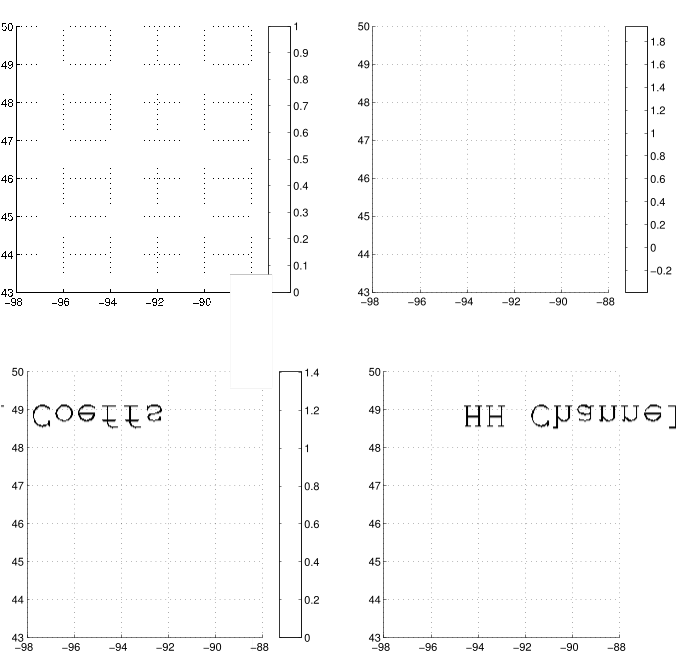
Fig. 11: The Delaunay triangulation plots of output wavelet coefficients of the proposed filterbanks with parameter m = 6. The edge-color reflects the value of the coefficients at that point. (a) original graph signal (b) LL channel wavelet coefficients (c) LH channel wavelet coefficients (d) HH channel wavelet coefficients 
Fig. 9: (a) The Minnesota traffic graph and (b) the scatter-plot of a graph-signal to be analyzed. The colors of the nodes represent the sample values. 
Fig. 10: Bipartite decomposition of Minnesota graph into two bipartite subgraphs using Harary’s decomposition.


Citations
Reduced dimension policy iteration for wireless network control via multiscale analysis
Marco Levorato,Sunil K. Narang,Urbashi Mitra,Antonio Ortega +3 more
- 01 Dec 2012
TL;DR: The proposed methodology is based on the intrinsic multi-dimensional/multi-scale structure of the state space of the FSM and enables the analysis and minimization of cost-to-go functions, i.e., functions measuring the expected long-term cost associated with a control strategy, on coarser versions of the original graph.
24
A fast algorithm for vertex-frequency representations of signals on graphs
TL;DR: The results showed that graphs can be reconstructed from the vertex-frequency representations obtained with the proposed algorithms and showed that noise has no effect on the results of the algorithm for the fast windowed graph Fourier transform or on the graph S-transform.
24
Distributed recursive least squares strategies for adaptive reconstruction of graph signals
Paolo Di Lorenzo,Elvin Isufi,Paolo Banelli,Sergio Barbarossa,Geert Leus +4 more
- 01 Aug 2017
TL;DR: A sparse sensing method is proposed that selects the sampling probability at each node in the graph in order to guarantee adaptive signal reconstruction and a target steady-state performance and a distributed RLS strategy is derived and is shown to be convergent to its centralized counterpart.
22
•Posted Content
Multiresolution Representations for Piecewise-Smooth Signals on Graphs
TL;DR: This paper models complex and irregular data as piecewise-smooth graph signals and proposes a graph dictionary to effectively represent those graph signals, and shows that the proposed graph dictionary outperforms eight other representation methods on six datasets, including traffic networks, social networks and point cloud meshes.
22
Multiscale Local Polynomial Smoothing in a Lifted Pyramid for Non-Equispaced Data
TL;DR: This paper integrates Burt-Adelson's Laplacian pyramids with lifting schemes for the construction of slightly redundant decompositions, and discusses several alternatives in the design of non-stationary finite impulse response filters for a stable multiresolution smoothing system.
References
Community structure in social and biological networks
Michelle Girvan,Mark Newman +1 more
TL;DR: This article proposes a method for detecting communities, built around the idea of using centrality indices to find community boundaries, and tests it on computer-generated and real-world graphs whose community structure is already known and finds that the method detects this known structure with high sensitivity and reliability.
A tutorial on spectral clustering
TL;DR: In this article, the authors present the most common spectral clustering algorithms, and derive those algorithms from scratch by several different approaches, and discuss the advantages and disadvantages of these algorithms.
A taxonomy and evaluation of dense two-frame stereo correspondence algorithms
TL;DR: This paper has designed a stand-alone, flexible C++ implementation that enables the evaluation of individual components and that can easily be extended to include new algorithms.
•Book
Spectral Graph Theory
Fan Chung
- 03 Dec 1996
TL;DR: Eigenvalues and the Laplacian of a graph Isoperimetric problems Diameters and eigenvalues Paths, flows, and routing Eigen values and quasi-randomness
7.1K
•Book
Wavelets and Subband Coding
Martin Vetterli,Jelena Kovacevic +1 more
- 01 Mar 1995
TL;DR: Wavelets and Subband Coding offered a unified view of the exciting field of wavelets and their discrete-time cousins, filter banks, or subband coding and developed the theory in both continuous and discrete time.
3.4K