
MOOSE: Enabling Massively Parallel Multiphysics Simulation.
Cody J. Permann,Derek Gaston,David Andrs,Robert W. Carlsen,Fande Kong,Alexander Lindsay,Jason M. Miller,John W. Peterson,Andrew E. Slaughter,Roy H. Stogner,Richard C. Martineau +10 more
TL;DR: The Multiphysics Object Oriented Simulation Environment (MOOSE) aims to enable development by providing simplified interfaces for specification of partial differential equations, boundary conditions, material properties, and all aspects of a simulation without the need to consider the parallel, adaptive, nonlinear, finite-element solve that is handled internally.
read more
Abstract: Harnessing modern parallel computing resources to achieve complex multi-physics simulations is a daunting task. The Multiphysics Object Oriented Simulation Environment (MOOSE) aims to enable such development by providing simplified interfaces for specification of partial differential equations, boundary conditions, material properties, and all aspects of a simulation without the need to consider the parallel, adaptive, nonlinear, finite-element solve that is handled internally. Through the use of interfaces and inheritance, each portion of a simulation becomes reusable and composable in a manner that allows disparate research groups to share code and create an ecosystem of growing capability that lowers the barrier for the creation of multiphysics simulation codes. Included within the framework is a unique capability for building multiscale, multiphysics simulations through simultaneous execution of multiple sub-applications with data transfers between the scales. Other capabilities include automatic differentiation, scaling to a large number of processors, hybrid parallelism, and mesh adaptivity. To date, MOOSE-based applications have been created in areas of science and engineering such as nuclear physics, geothermal science, magneto-hydrodynamics, seismic events, compressible and incompressible fluid flow, microstructure evolution, and advanced manufacturing processes.
read more
Chat with Paper
AI Agents for this Paper
Find similar papers on Google Scholar, PubMed and Arxiv
Write a critical review of this paper
Analyze citations of this paper to find unaddressed research gaps
Figures

Table 1: Code metadata (mandatory) 
Figure 1: Scaling study of MOOSE using up to 32,768 processor cores. Each data point is annotated with the total compute time and the parallel efficiency. The total computed time does not include the input/ouptut cost and the mesh preparation. 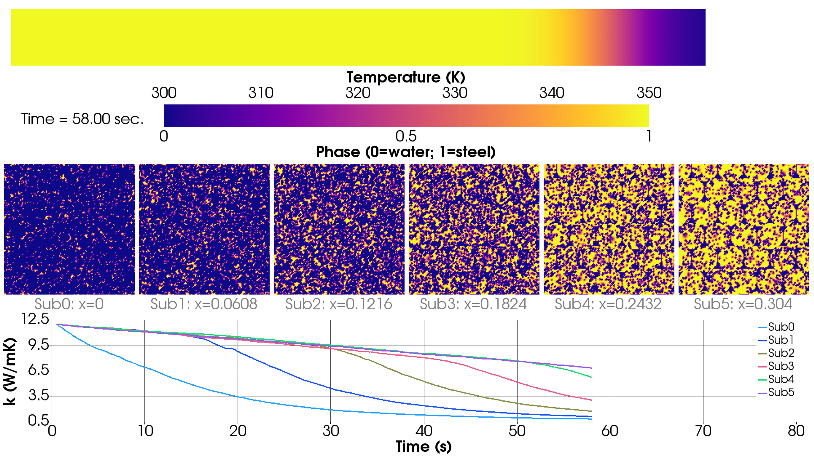
Figure 2: Results after 58 seconds of simulation for a thermo-mechanical problem with feedback from a micro-structure calculation that shows the temperature at the engineering scale, the geometry of each degraded micro-structure, and the effective thermal conductivity over time for each of the micro-structure calculations.


Citations
life: A flexible, high performance library for the numerical solution of complex finite element problems
TL;DR: In this paper , the authors introduce the design and capabilities of lifex, an open source C++ library for high performance finite element simulations of multiphysics, multiscale, and multidomain problems.
43
Cluster dynamics simulation of xenon diffusion during irradiation in UO2
Christopher Matthews,Romain Perriot,Michael M.D. Cooper,Christopher R. Stanek,David A. Andersson +4 more
TL;DR: In this paper, the authors applied Free Energy Cluster Dynamics (FECD) methodology in the code Centipede to calculate xenon cluster concentrations in UO2 under intrinsic (high temperature) and irradiation-enhanced (intermediate temperature) conditions in order to develop a model of the xenon diffusion coefficient based on the atomic scale mechanisms responsible for transport.
43
Microscale residual stresses in additively manufactured stainless steel: Computational simulation
TL;DR: In this paper , a computational framework is used to study how residual stresses form and evolve in AM parts at the length scale of individual grains, including a multi-physics thermal-fluid flow model, a phase field model for grain growth and a crystal plasticity finite element model.
43
Automatic Differentiation in MetaPhysicL and Its Applications in MOOSE
Alexander Lindsay,Roy H. Stogner,Derek Gaston,Daniel Schwen,Christopher Matthews,Wen Jiang,Larry K. Aagesen,Robert W. Carlsen,Fande Kong,Andrew E. Slaughter,Cody J. Permann,Richard C. Martineau +11 more
TL;DR: The application of MOOSE’s AD capability to several sets of physics that were previously infeasible to model via hand-coded or Jacobian-free simulation techniques, including arbitrary Lagrangian-Eulerian and level-set simulations of laser melt pools, phase-field simulations with free energies provided through neural networks, and metallic nuclear fuel simulations that require inner Newton loop calculation of nonlinear material properties are described.
41
Multiphysics phase-field modeling of quasi-static cracking in urania ceramic nuclear fuel
Wei Li,Koroush Shirvan +1 more
TL;DR: In this article, a phase-field modeling of quasi-static cracking in urania (UO2) ceramic nuclear fuel under neutron radiation at high temperatures is presented, where a diffusion model including Fickian and Soret effects is used to describe the oxygen hyper-stoichiometry (x in UO2+x), and the temperature field is given by a thermal model involving non-uniform fission-generated heat source and heat flow across fuel pellet, pellet-cladding gap and cladding to the outside heat sink.
41
References
GMRES: a generalized minimal residual algorithm for solving nonsymmetric linear systems
Youcef Saad,Martin H. Schultz +1 more
TL;DR: An iterative method for solving linear systems, which has the property of minimizing at every step the norm of the residual vector over a Krylov subspace.
The FEniCS Project Version 1.5
Martin Sandve Alnæs,Jan Blechta,Johan Hake,August Johansson,Benjamin Kehlet,Anders Logg,Chris N. Richardson,Johannes Ring,Marie E. Rognes,Garth N. Wells +9 more
- 07 Dec 2015
TL;DR: The FEniCS Project is a collaborative project for the development of innovative concepts and tools for automated scientific computing, with a particular focus on the solution of differential equations by finite element methods.
2.4K
•Book
Domain Decomposition: Parallel Multilevel Methods for Elliptic Partial Differential Equations
Barry Smith,Petter E. Bjorstad,William Gropp +2 more
- 13 Jun 1996
TL;DR: 1. One level algorithms 2. Two level algorithms 3. Multilevel algorithms 4. Substructuring methods 5. A convergence theory
2.2K
Efficient management of parallelism in object-oriented numerical software libraries
Satish Balay,William Gropp,Lois Curfman McInnes,Barry Smith +3 more
- 01 May 1997
TL;DR: The PETSc 2.0 package as discussed by the authors uses object-oriented programming to conceal the details of the message passing, without concealing the parallelism, in a high-quality set of numerical software libraries.
2.1K
Jacobian-free Newton-Krylov methods: a survey of approaches and applications
Dana A. Knoll,David E. Keyes +1 more
TL;DR: The aim of this paper is to present the reader with a perspective on how JFNK may be applicable to applications of interest and to provide sources of further practical information.
2.1K