
MOOSE: Enabling Massively Parallel Multiphysics Simulation.
Cody J. Permann,Derek Gaston,David Andrs,Robert W. Carlsen,Fande Kong,Alexander Lindsay,Jason M. Miller,John W. Peterson,Andrew E. Slaughter,Roy H. Stogner,Richard C. Martineau +10 more
TL;DR: The Multiphysics Object Oriented Simulation Environment (MOOSE) aims to enable development by providing simplified interfaces for specification of partial differential equations, boundary conditions, material properties, and all aspects of a simulation without the need to consider the parallel, adaptive, nonlinear, finite-element solve that is handled internally.
read more
Abstract: Harnessing modern parallel computing resources to achieve complex multi-physics simulations is a daunting task. The Multiphysics Object Oriented Simulation Environment (MOOSE) aims to enable such development by providing simplified interfaces for specification of partial differential equations, boundary conditions, material properties, and all aspects of a simulation without the need to consider the parallel, adaptive, nonlinear, finite-element solve that is handled internally. Through the use of interfaces and inheritance, each portion of a simulation becomes reusable and composable in a manner that allows disparate research groups to share code and create an ecosystem of growing capability that lowers the barrier for the creation of multiphysics simulation codes. Included within the framework is a unique capability for building multiscale, multiphysics simulations through simultaneous execution of multiple sub-applications with data transfers between the scales. Other capabilities include automatic differentiation, scaling to a large number of processors, hybrid parallelism, and mesh adaptivity. To date, MOOSE-based applications have been created in areas of science and engineering such as nuclear physics, geothermal science, magneto-hydrodynamics, seismic events, compressible and incompressible fluid flow, microstructure evolution, and advanced manufacturing processes.
read more
Chat with Paper
AI Agents for this Paper
Find similar papers on Google Scholar, PubMed and Arxiv
Write a critical review of this paper
Analyze citations of this paper to find unaddressed research gaps
Figures

Table 1: Code metadata (mandatory) 
Figure 1: Scaling study of MOOSE using up to 32,768 processor cores. Each data point is annotated with the total compute time and the parallel efficiency. The total computed time does not include the input/ouptut cost and the mesh preparation. 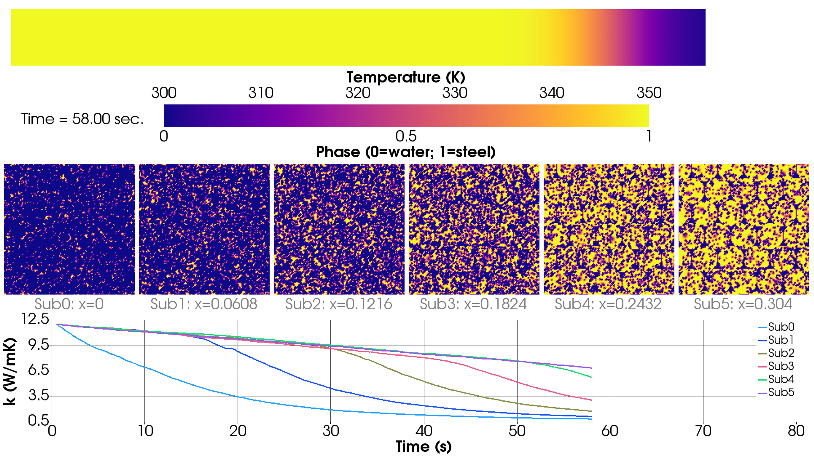
Figure 2: Results after 58 seconds of simulation for a thermo-mechanical problem with feedback from a micro-structure calculation that shows the temperature at the engineering scale, the geometry of each degraded micro-structure, and the effective thermal conductivity over time for each of the micro-structure calculations.


Citations
A thermo-mechanical phase-field fracture model: Application to hot cracking simulations in additive manufacturing
TL;DR: In this article , a thermodynamic phase-field fracture model is proposed to simulate the hot cracking in additive manufacturing, where not only the thermal strain but also the solidification shrinkage is considered.
Unsupervised Learning-Based Multiscale Model of Thermochemistry in 1,3,5-Trinitro-1,3,5-triazinane (RDX)
Michael Sakano,Ahmed Hamed,Edward M. Kober,Nicolò Grilli,Brenden W. Hamilton,Mahbubul Islam,Marisol Koslowski,Alejandro Strachan +7 more
TL;DR: A multiscale model for 1,3,5-trinitro-1,3-5-triazinane, RDX, where a continuum description is informed by reactive and nonreactive molecular dynamics simulations to describe chemical reactions and thermal transport is developed.
58
Study of grain boundary orientation gradients through combined experiments and strain gradient crystal plasticity modeling
TL;DR: In this paper , a combined experimental and strain gradient crystal plasticity framework is presented for studying the development of orientation and misorientation gradients at the grain boundaries during plastic deformation.
56
Unveiling the Mechanical and Electrochemical Evolution of Nanosilicon Composite Anodes in Sulfide‐Based All‐Solid‐State Batteries
Daxian Cao,Tongtai Ji,Avtar Singh,Seong-Min Bak,Yonghua Du,Xianghui Xiao,Hongyi Xu,Juner Zhu,Hongli Zhu +8 more
TL;DR: In this paper , operando X-ray absorption near-edge structure (XANES) spectroscopy, ex situ scanning electron microscopy (SEM), and ex situ X−ray nanotomography (XnT) were used to investigate the chemistry and structure evolution of nano-Si composite anodes.
50
Gas Sensors Based on Localized Surface Plasmon Resonances: Synthesis of Oxide Films with Embedded Metal Nanoparticles, Theory and Simulation, and Sensitivity Enhancement Strategies
Marcos Rodrigues,Joel Nuno Pinto Borges,C. Lopes,Rui M. S. Pereira,Mikhail Vasilevskiy,Filipe Vaz +5 more
TL;DR: In this article, the Portuguese Foundation for Science and Technology (FCT) funded the research of Marco S. Rodrigues and his colleagues in the context of the Strategic Funding UIDB/04650/2020.
46
References
GMRES: a generalized minimal residual algorithm for solving nonsymmetric linear systems
Youcef Saad,Martin H. Schultz +1 more
TL;DR: An iterative method for solving linear systems, which has the property of minimizing at every step the norm of the residual vector over a Krylov subspace.
The FEniCS Project Version 1.5
Martin Sandve Alnæs,Jan Blechta,Johan Hake,August Johansson,Benjamin Kehlet,Anders Logg,Chris N. Richardson,Johannes Ring,Marie E. Rognes,Garth N. Wells +9 more
- 07 Dec 2015
TL;DR: The FEniCS Project is a collaborative project for the development of innovative concepts and tools for automated scientific computing, with a particular focus on the solution of differential equations by finite element methods.
2.4K
•Book
Domain Decomposition: Parallel Multilevel Methods for Elliptic Partial Differential Equations
Barry Smith,Petter E. Bjorstad,William Gropp +2 more
- 13 Jun 1996
TL;DR: 1. One level algorithms 2. Two level algorithms 3. Multilevel algorithms 4. Substructuring methods 5. A convergence theory
2.2K
Efficient management of parallelism in object-oriented numerical software libraries
Satish Balay,William Gropp,Lois Curfman McInnes,Barry Smith +3 more
- 01 May 1997
TL;DR: The PETSc 2.0 package as discussed by the authors uses object-oriented programming to conceal the details of the message passing, without concealing the parallelism, in a high-quality set of numerical software libraries.
2.1K
Jacobian-free Newton-Krylov methods: a survey of approaches and applications
Dana A. Knoll,David E. Keyes +1 more
TL;DR: The aim of this paper is to present the reader with a perspective on how JFNK may be applicable to applications of interest and to provide sources of further practical information.
2.1K