
Open Access
Millimeter wave beamforming for wireless backhaul and access in small cell networks and practical approaches in software-defined radio
James V. Krogmeier,David J. Love,Sooyoung Hur +2 more
- 01 Jan 2013
TL;DR: In this paper, an efficient beam alignment technique using adaptive subspace sampling and hierarchical beam codebooks was proposed to solve the problem of spectrum reusability and flexible prototyping radio platform using software-defined radio (SDR).
read more
Abstract: Mobile data traffic will continue its tremendous growth in some markets, and has already resulted in an apparent radio spectrum scarcity. There is a strong need for more efficient methods to use spectrum resources, leading to extensive research on increasing spectrum reusability on flexible radio platforms. This study solves this problem in two sub topics, millimeter wave communication on wireless backhaul for spectrum reusability, and flexible prototyping radio platform using software-defined radio (SDR).
Wireless backhaul has received significant attention as a key technology affecting the development of future wireless cellular networks because it helps to easily deploy many small size cells, an essential part of a high capacity system. Millimeter wave is considered a possible candidate for cost-effective wireless backhaul. In the outdoor deployment using a millimeter wave, beamforming methods are key techniques to establish wireless links in the 60 GHz to 80 GHz to overcome pathloss constraints (i.e., rainfall effect and oxygen absorption). The millimeter wave communication system cannot directly access the channel knowledge. To overcome this, a beamforming method based on codebook search is considered. The millimeter wave communication cannot access channel knowledge, therefore alternatively a beamforming method based on a codebook search is considered. In the first part, we propose an efficient beam alignment technique using adaptive subspace sampling and hierarchical beam codebooks. A wind sway analysis is presented to establish a notion of beam coherence time. This highlights a previously unexplored tradeoff between array size and wind-induced movement. Generally, it is not possible to use larger arrays without risking a performance loss from wind-induced beam misalignment. The performance of the proposed alignment technique is analyzed and compared with other search and alignment methods. Results show significant performance improvement with reduced search time.
In the second part of this study, SDR is discussed as an approach toward flexible wireless communication systems. Most layers of SDR are implemented by software. Therefore, only a software change is needed to transform the type of radio system. The translation of the signal processing into software performed by a regular computer opens up a huge number of possibilities at a reasonable price and effort. SDR systems are widely used to build prototypes, saving time and money. In this project, a robust wireless communication system in high interference environment was developed. For the physical layer (PHY) of the system, we implemented a channel sub-bandding method that utilizes frequency division multiplexing to avoid interference. Then, to overcome a further interfered channel, Direct Spread Spectrum System (DSSS) was considered and implemented. These prototyped testbeds were evaluated for system performance in the interference environment.
read more
Chat with Paper
AI Agents for this Paper
Find similar papers on Google Scholar, PubMed and Arxiv
Write a critical review of this paper
Analyze citations of this paper to find unaddressed research gaps
Figures
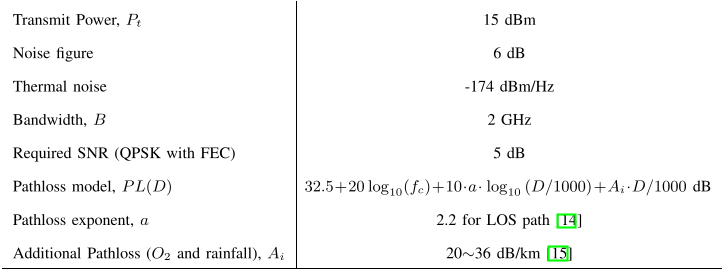
TABLE I SYSTEM LINK-BUDGET 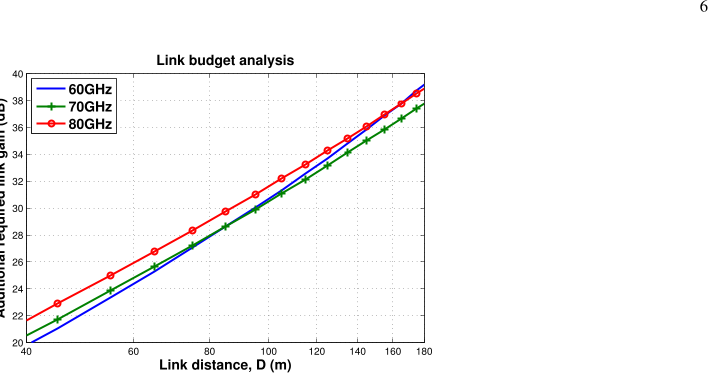
Fig. 2. Link budget analysis for the required gain versus link distance. 
Fig. 12. Comparison of beamforming gain versus beam search time L for M = 32 array, SNR = 5 dB. 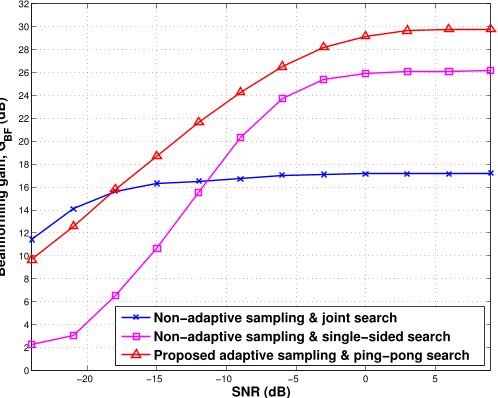
Fig. 11. Comparison of beamforming gain versus SNR for M = 32 array, L = 48. 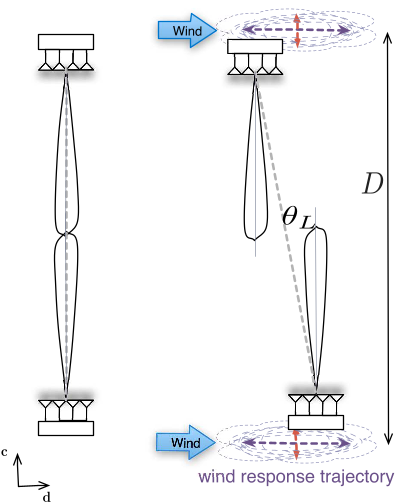
Fig. 5. Example pole movement showing beam deflection due to wind. 
Fig. 8. Hierarchical structure of subcodebooks Fk and expansions between subcodebooks.


Citations
Line-of-Sight MIMO for High Capacity Millimeter Wave Backhaul in FDD Systems
Ye Xue,Xuanyu Zheng,Vincent Kin Nang Lau +2 more
- 30 Jun 2020
TL;DR: This paper proposes a holistic solution containing TO compensation, PHN estimation, precoder/decorrelator optimization of the LoS MIMO for wireless backhaul, and the interleaving of each part and shows that the proposed solution has a robust performance with end-to-end spectral efficiency of 60 bit/s/Hz for 8 × 8 MIMo.
23
Fast Position-Aided MIMO Beam Training via Noisy Tensor Completion
TL;DR: A data-driven position-aided approach is proposed to reduce the training overhead in MIMO systems by leveraging side information and on-the-field measurements, and an online HNTC method via warm-start is proposed, that alleviates the computational complexity by 50%, with no degradation in prediction accuracy.
22
Deep Neural Hybrid Beamforming for Multi-User mmWave Massive MIMO System
Jiyun Tao,Jing Xing,Jienan Chen,Chuan Zhang,Shengli Fu +4 more
- 01 Nov 2019
TL;DR: This work proposes a deep neural network based HB for the multi-User mmWave massive MIMO system, referred as DNHB, formulated as an autoencoder neural network, which is trained in a style of end-to-end self-supervised learning.
21
Constrained Deep Neural Network Based Hybrid Beamforming for Millimeter Wave Massive MIMO Systems
Jiyun Tao,Qi Wang,Siyu Luo,Jienan Chen +3 more
- 20 May 2019
TL;DR: A constrained deep neural network (constrained-DNN) based hybrid beamforming for mmWave massive MIMO system is proposed, which employs neural networks to replace the beamforming matrices in traditional Hybrid beamforming to achieve end-to-end autonomous hybrids beamforming.
21
Position estimation with a millimeter-wave massive MIMO system based on distributed steerable phased antenna arrays
TL;DR: A massive MIMO (multiple-input-multiple-output) architecture with distributed steerable phased antenna subarrays for position estimation in the mmWave range and a multistage/multiresolution search strategy that resolve the problem of high side lobes is proposed.
References
•Book
Digital Communications
John G. Proakis
- 01 Jan 1983
TL;DR: This month's guest columnist, Steve Bible, N7HPR, is completing a master’s degree in computer science at the Naval Postgraduate School in Monterey, California, and his research area closely follows his interest in amateur radio.
27.7K
What Will 5G Be
Jeffrey G. Andrews,Stefano Buzzi,Wan Choi,Stephen V. Hanly,Angel Lozano,Anthony C. K. Soong,Jianzhong Charlie Zhang +6 more
TL;DR: This paper discusses all of these topics, identifying key challenges for future research and preliminary 5G standardization activities, while providing a comprehensive overview of the current literature, and in particular of the papers appearing in this special issue.
An Overview of Signal Processing Techniques for Millimeter Wave MIMO Systems
TL;DR: This article provides an overview of signal processing challenges in mmWave wireless systems, with an emphasis on those faced by using MIMO communication at higher carrier frequencies.
3.1K
Millimeter-Wave Cellular Wireless Networks: Potentials and Challenges
Sundeep Rangan,Theodore S. Rappaport,Elza Erkip +2 more
- 05 Feb 2014
TL;DR: Measurements and capacity studies are surveyed to assess mmW technology with a focus on small cell deployments in urban environments and it is shown that mmW systems can offer more than an order of magnitude increase in capacity over current state-of-the-art 4G cellular networks at current cell densities.
2.9K
•Book
Optimum Array Processing: Part IV of Detection, Estimationand Modulation Theory
Harry L. Van Trees
- 01 Jan 2013
TL;DR: Optimum array processing: part IV of detection, estimation and modulation theory, Optimum arrayprocessing: part III of detection- estimation-modulation theory.
2.9K