
Lung nodules: size still matters
Anna Rita Larici,Alessandra Farchione,Paola Franchi,Mario Ciliberto,Giuseppe Cicchetti,Lucio Calandriello,Annemilia Del Ciello,Lorenzo Bonomo +7 more
TL;DR: Predictive models have been proposed as a potential means to overcome the limitations of a sized-based assessment of the malignancy risk for indeterminate pulmonary nodules.
read more
Abstract: The incidence of indeterminate pulmonary nodules has risen constantly over the past few years. Determination of lung nodule malignancy is pivotal, because the early diagnosis of lung cancer could lead to a definitive intervention. According to the current international guidelines, size and growth rate represent the main indicators to determine the nature of a pulmonary nodule. However, there are some limitations in evaluating and characterising nodules when only their dimensions are taken into account. There is no single method for measuring nodules, and intrinsic errors, which can determine variations in nodule measurement and in growth assessment, do exist when performing measurements either manually or with automated or semi-automated methods. When considering subsolid nodules the presence and size of a solid component is the major determinant of malignancy and nodule management, as reported in the latest guidelines. Nevertheless, other nodule morphological characteristics have been associated with an increased risk of malignancy. In addition, the clinical context should not be overlooked in determining the probability of malignancy. Predictive models have been proposed as a potential means to overcome the limitations of a sized-based assessment of the malignancy risk for indeterminate pulmonary nodules.
read more
Chat with Paper
AI Agents for this Paper
Find similar papers on Google Scholar, PubMed and Arxiv
Write a critical review of this paper
Analyze citations of this paper to find unaddressed research gaps
Figures
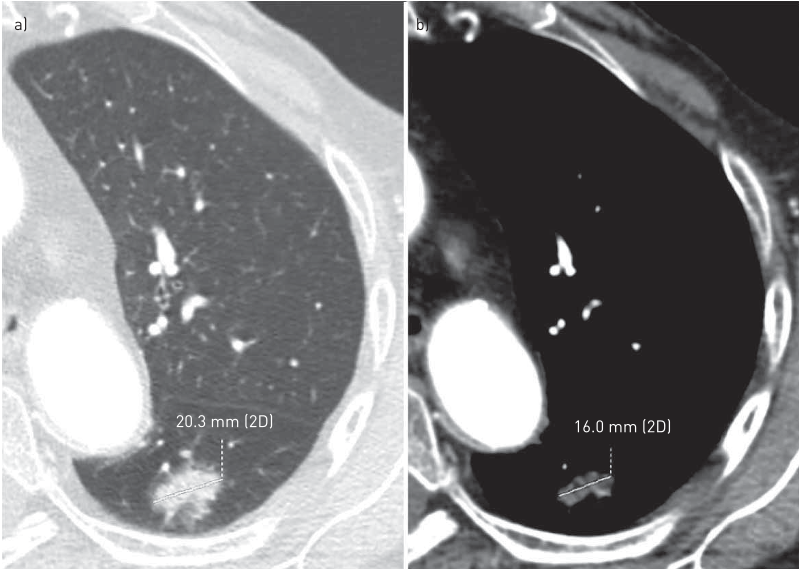
FIGURE 2 Disagreement in measuring the solid portion of a part-solid nodule when using different reconstruction algorithms and window settings. A part-solid nodule in the apical segment of left lower lobe is shown. a) By using a high-spatial frequency algorithm and the lung window, the measured maximum axial diameter of the solid portion of the nodule corresponds to 20.3 mm; b) by using a smooth algorithm and the mediastinal window, the measured maximum axial diameter of the solid portion of the nodule corresponds to 16 mm. 2D: two-dimensional. 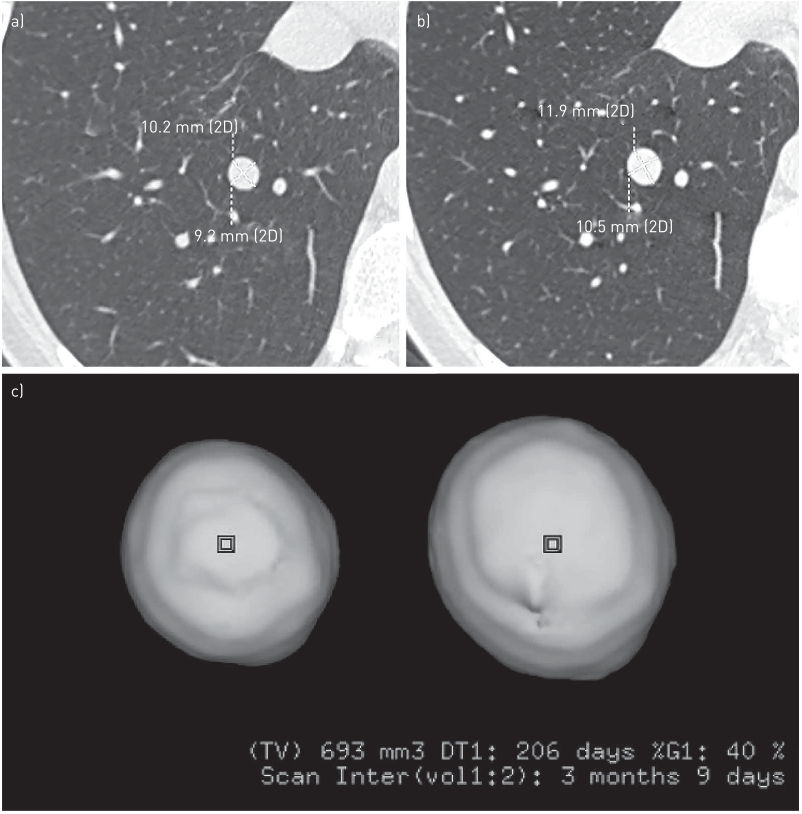
FIGURE 3 Volume evaluation during follow-up allows the detection of nodule growth over a shorter period of time compared to diameter estimation. a) Computed tomography (CT) axial image shows the same nodule located in the right lower lobe as reported in figure 1c; b) a 3-month follow-up axial CT image demonstrates minimal change in nodule diameters; c) conversely, nodule volume calculation using a three-dimensional (3D) volumetric method demonstrates a significant increase in volume within the range of malignancy. Histopathology revealed a carcinoid tumour. 2D: two-dimensional; TV: total volume; DT: volume doubling time; %G: volume increase; scan inter: scan interval. Squares in the nodule represent the starting points of the 3D analysis. 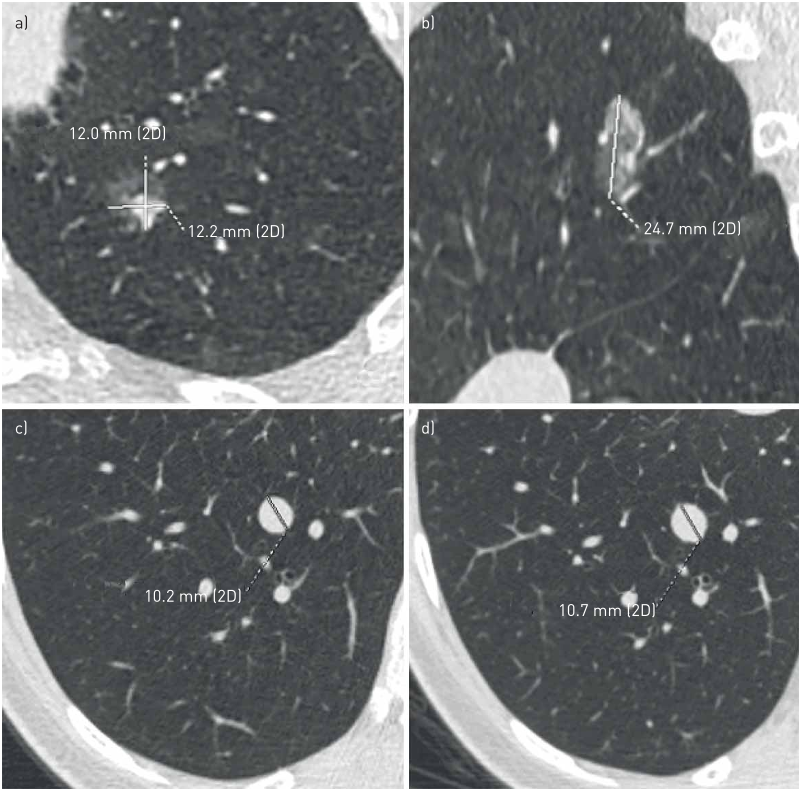
FIGURE 1 Limitations of two-dimensional (2D) measurements. The axial diameter may not be the maximum one in the evaluation of lung nodules. a) A small part-solid nodule in the apico-posterior segment of the left upper lobe, with a maximum axial diameter of 12×12.2 mm; b) the sagittal multiplanar reconstruction shows that the largest diameter of the same nodule is the sagittal one of 24.7 mm. The multiplanar evaluation of nodule diameter is especially important to document asymmetrical growth of nodules. c), d) The low level of agreement when measuring small nodules: for the same nodule in the right lower lobe two different diameter values have been reported by two readers. Considering the nearest whole diameter of the two values, it results in 1 mm difference in the maximum diameter, a significant difference when considering small nodules.


Citations
Radiomics Improves Cancer Screening and Early Detection
TL;DR: The inexorable improvements in radiomics to build more robust classifier models and the significant limitations to this development, including access to well-annotated databases, and biological descriptors of the imaged feature data are discussed.
Lung-RADS Version 1.1: Challenges and a Look Ahead, From the AJR Special Series on Radiology Reporting and Data Systems
Lydia Chelala,Rydhwana Hossain,Ella A. Kazerooni,Jared D. Christensen,Debra S. Dyer,Charles S. White +5 more
TL;DR: Lung-RADS as discussed by the authors provides a common lexicon and standardized nodule follow-up management paradigm for use when reporting lung cancer screening (LCS) low-dose CT (LDCT) chest examinations and serves as a quality assurance and outcome monitoring tool.
68
Diagnosis and management of peripheral lung nodule
TL;DR: A solitary pulmonary nodule (SPN) is a well-defined radiographic opacity up to 3 cm in diameter that is surrounded by unaltered aerated lung that is an incidental finding on chest radiographs and chest CT scans.
56
Application of Radiomics in Predicting the Malignancy of Pulmonary Nodules in Different Sizes.
TL;DR: The radiomic T1a model showed superior prediction performance to the T1b and T1c models, and the best performance in terms of AUC and sensitivity was found for predicting the malignancy of T1A PN.
52
References
Volumetric measurement of pulmonary nodules at low-dose chest CT: Effect of reconstruction setting on measurement variability
Ying Wang,Geertruida H. de Bock,Rob J. van Klaveren,Peter M. A. van Ooyen,W Tukker,Yingru Zhao,Monique D. Dorrius,Rozemarijn Vliegenthart Proenca,Wendy J. Post,Matthijs Oudkerk +9 more
TL;DR: A wide, nodule-type-dependent range of agreement between volume measurements with different reconstruction settings suggests strict consistency is required for serial CT studies.
Pulmonary nodules: detection with low-dose vs conventional-dose spiral CT
Gartenschläger M,Franz Schweden,K. K. Gast,T. Westermeier,HU Kauczor,H. von Zitzewitz,Manfred Thelen +6 more
TL;DR: If clinical circumstances require dose minimization, low-dose spiral CT may be advocated as an alternative screening method to conventional dose spiral CT in the detection and assessment of contours of pulmonary nodules.
63
Detection and quantification of the solid component in pulmonary subsolid nodules by semiautomatic segmentation
Ernst Th. Scholten,Colin Jacobs,Bram van Ginneken,Sarah J. van Riel,Rozemarijn Vliegenthart,Rozemarijn Vliegenthart,Matthijs Oudkerk,Harry J. de Koning,Nanda Horeweg,Mathias Prokop,Hester A. Gietema,Willem Th. M. Mali,Pim de Jong +12 more
TL;DR: Semiautomatic segmentation of subsolid nodules could diagnose part-solid nodules and quantify the solid component similar to human observers, and performance depends on the attenuation segmentation thresholds.
Lung nodule volumetry: segmentation algorithms within the same software package cannot be used interchangeably
Haseem Ashraf,B.J. de Hoop,Saher B. Shaker,Asger Dirksen,K.S. Bach,Hanne Foss Hansen,Mathias Prokop,Mathias Prokop,Jesper Holst Pedersen +8 more
TL;DR: Modern volumetric software failed to correctly segment a high number of screen detected nodules and reproducibility of volumetry measurements deteriorates substantially when different algorithms were used.
Automated assessment of malignant degree of small peripheral adenocarcinomas using volumetric CT data: Correlation with pathologic prognostic factors
Masahiro Yanagawa,Yuko Tanaka,Masahiko Kusumoto,Shun-ichi Watanabe,Ryosuke Tsuchiya,Osamu Honda,Hiromitsu Sumikawa,Atsuo Inoue,Masayoshi Inoue,Meinoshin Okumura,Noriyuki Tomiyama,Takeshi Johkoh +11 more
TL;DR: Using a custom-developed software, it is feasible to predict the pathological prognostic factors of small peripheral adenocarcinomas using two-dimensional rates of solid parts to total opacity.
52
Related Papers (5)
Annette McWilliams,Martin C. Tammemägi,John R. Mayo,Heidi C. Roberts,Geoffrey Liu,Kam Soghrati,Kazuhiro Yasufuku,Simon Martel,Francis Laberge,Michel Gingras,S. Atkar-Khattra,Christine D. Berg,Kenneth R. Evans,Richard J. Finley,John Yee,John C. English,Paola Nasute,John R. Goffin,Serge Puksa,Lori Stewart,Scott Tsai,Michael R. Johnston,Daria Manos,Garth Nicholas,Glenwood D. Goss,Jean M. Seely,Kayvan Amjadi,Alain Tremblay,Paul Burrowes,Paul MacEachern,Rick Bhatia,Ming-Sound Tsao,Stephen Lam +32 more
Samuel G. Armato,Geoffrey McLennan,Luc Bidaut,Michael F. McNitt-Gray,Charles R. Meyer,Anthony P. Reeves,Binsheng Zhao,Denise R. Aberle,Claudia I. Henschke,Eric A. Hoffman,Ella A. Kazerooni,Heber MacMahon,Edwin J. R. van Beek,David F. Yankelevitz,Alberto Biancardi,Peyton H. Bland,Matthew S. Brown,Roger Engelmann,Gary E. Laderach,Daniel Max,Richard C. Pais,David Qing,Rachael Y. Roberts,Amanda R. Smith,Adam Starkey,Poonam Batra,Philip Caligiuri,Ali Farooqi,Gregory W. Gladish,C. Matilda Jude,Reginald F. Munden,Iva Petkovska,Leslie E. Quint,Lawrence H. Schwartz,Baskaran Sundaram,Lori E. Dodd,Charles Fenimore,David Gur,Nicholas Petrick,John Freymann,Justin Kirby,Brian Hughes,Alessi Vande Casteele,Sangeeta Gupte,Maha Sallam,Michael D. Heath,Michael Kuhn,Ekta Dharaiya,Richard Burns,David Fryd,Marcos Salganicoff,Vikram Anand,Uri Shreter,Stephen Vastagh,Barbara Y. Croft,Laurence P. Clarke +55 more