
Exact Dimer Ground State of the Two Dimensional Heisenberg Spin System SrCu 2 ( BO 3 ) 2
Shin Miyahara,Kazuo Ueda +1 more
TL;DR: In this paper, the critical value of the quantum phase transition from the dimer state to the N'eel ordered state is determined, and the experimental data shows that the two dimensional Heisenberg model has an exact dimer ground state which was proven by Shastry and Sutherland almost twenty years ago.
read more
Abstract: The two dimensional Heisenberg model for ${\mathrm{SrCu}}_{2}({\mathrm{BO}}_{3}{)}_{2}$ has an exact dimer ground state which was proven by Shastry and Sutherland almost twenty years ago. The critical value of the quantum phase transition from the dimer state to the N\'eel ordered state is determined. Analysis of the experimental data shows that $\mathrm{SrCu}{}_{2}(\mathrm{BO}{}_{3}{)}_{2}$ has the dimer ground state but its coupling constants are close to the transition point, which leads to an unusual temperature dependence of the susceptibility. The almost localized nature of the triplet excitations explains the plateaus observed in the magnetization curve.
read more
Chat with Paper
AI Agents for this Paper
Find similar papers on Google Scholar, PubMed and Arxiv
Write a critical review of this paper
Analyze citations of this paper to find unaddressed research gaps
Figures

FIG. 4. Temperature dependence of susceptibility for finite clusters, N = 8 and 16. J = 100 K and J ′ = 68 K are used. The experimental data are shown by the thick solid line. Also shown are the theoretical results for smaller values of the ratio J ′ /J = 0(dimer), 0.2, 0.4 with the Weiss constant fixed θ = 92.5 K. 
FIG. 3. Spin gap for finite lattices: N = 8, 16, 20. The solid line is the perturbation result up to the fourth order. The dashed line is a fit obtained by adding fifth and sixth order terms to the perturbation result. 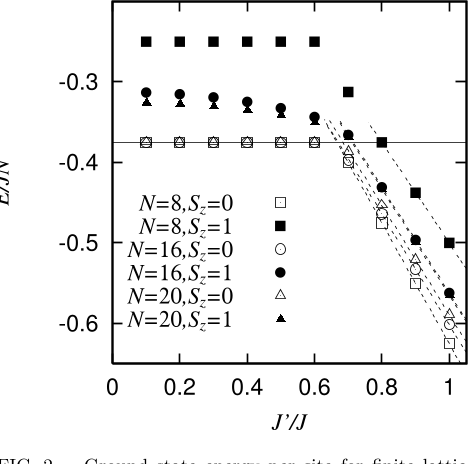
FIG. 2. Ground state energy per site for finite lattices: N = 8, 16, 20. The lowest energies of triplet excitations are also shown by filled symbols. 
FIG. 5. Magnetization process for the finite cluster of 20 spins. J = 100 K and J ′ = 68 K are used. 
FIG. 1. (a) Lattice structure of the Cu2+ spins of SrCu2(BO3)2. The nearest-neighbor bonds are expressed by solid lines and the next-nearest-neighbor bonds by broken lines. Square unit cells containing 4, 8, 16, 20 spins are shown by dashed lines. (b) Elementary unit for the interaction between a pair of nearest-neighbor bonds.


Citations
Quantum Phase Transitions in the Shastry-Sutherland Model for SrCu 2 \(BO 3 \) 2
Akihisa Koga,Norio Kawakami +1 more
TL;DR: It is found that a novel spin-gap phase, adiabatically connected to the plaquette-singlet phase, exists between the dimer and the magnetically ordered phases known thus far.
247
Controlling frustrated liquids and solids with an applied field in a kagome Heisenberg antiferromagnet.
TL;DR: A magnetic field is applied and a series of spin-gapped phases appearing at five different fractions of magnetization are discovered by means of a grand canonical density matrix renormalization group, an unbiased state-of-the-art numerical technique.
Tensor network study of the Shastry-Sutherland model in zero magnetic field
Philippe Corboz,Frédéric Mila +1 more
TL;DR: In this paper, the authors simulate the Shastry-Sutherland model in two dimensions by means of infinite projected entangled-pair states (iPEPS)-a variational tensor network method where the accuracy can be systematically controlled by the so-called bond dimension.
Milestones of low-D quantum magnetism
Alexander N. Vasiliev,Alexander N. Vasiliev,Alexander N. Vasiliev,Olga S. Volkova,Olga S. Volkova,Olga S. Volkova,Elena A. Zvereva,Elena A. Zvereva,M.M. Markina +8 more
- 28 Mar 2018
TL;DR: A long time gap between the formulation of the basic theory of low-dimensional (low-D) magnetism as advanced by Ising, Heisenberg and Bethe and its experimental verification is bridged by the discovery of high-TC superconductivity in cuprates as mentioned in this paper.
Hall effect of triplons in a dimerized quantum magnet
TL;DR: In this paper, the Dzyaloshinskii-Moriya interaction was shown to give rise to topological behavior in the archetypal quantum magnet strontium copper borate.
References
Exact ground state of a quantum mechanical antiferromagnet
TL;DR: In this paper, the ground state of a quantum mechanical antiferromagnetic model with next-nearest neighbor interactions was studied. But the results for the model were not exact.
795
Observation of a spin gap in SrCu2O3 comprising Ssin-12 quasi-1D two-leg ladders.
TL;DR: The spin gap observed for Sr $2 and $3 confirms a recent theoretical prediction for the magnetic behavior of spin = \textonehalf{} antiferromagnetically coupled Heisenberg chains.
735
Cluster Transfer-Matrix Method for One-Dimensional Quantum Spin Systems
TL;DR: In this article, a formulation is given to map the one-dimensional 5 = 1/2 quantum spin systems onto the two-dimensional Ising model with many spin interactions on the basis of the n-spin cluster decomposition (n CLD).
Spin Gap Behavior of S=1/2 Quasi-Two-Dimensional System CaV4O9
Satoshi Taniguchi,Takashi Nishikawa,Yukio Yasui,Yoshiaki Kobayashi,Masatoshi Sato,Takashi Nishioka,Masaaki Kontani,Kazuhiro Sano +7 more
TL;DR: In this paper, the spin susceptibility and spin-lattice relaxation rate of 51 V nuclear moments of CaV 4 O 9 with tetragonal structure have been measured and the first example of quasi-two-dimensional spin systems with spin gap was provided.
Observation of spin gap in CaV2O5 by NMR
TL;DR: In this paper, it was shown that the ground state of the spin system in CaV 2 O 5 is a spin singlet state and the energy gap between ground state and excited state was estimated to be about 500 K from the activation-like behavior of χ and 1/T 1.