
Development of Ultralow Interfacial Tension Lignosulfonate from Kraft Black Liquor for Enhanced Oil Recovery
Muhammad Mufti Azis,Fergie Febrina,Ignesti Anindia,Galuh Almas Darmawati,Desi Amalia Fenyka,Suryo Purwono,Rochmadi Rochmadi +6 more
TL;DR: In this paper, a low-cost lignosulfonate surfactant production from kraft black liquor (BL) was demonstrated, where lignin was isolated from black liquor using a novel CO2 bubbling technique, followed by addition of coagulants.
read more
Abstract: Indonesia aims to implement large-scale enhanced oil recovery (EOR) to increase the national oil production. Chemical EOR is a promising technology to boost the production of old reservoirs with the aid of surfactants and polymers. Thus, the production of low-cost EOR surfactants from local resources with acceptable performance is highly attractive. The objective of the present work was to demonstrate the development of low-cost lignosulfonate surfactant production from kraft black liquor (BL). First, lignin was isolated from black liquor using a novel CO2 bubbling technique, followed by addition of coagulants. Next, sodium lignosulfonate (SLS) was synthesized from the resulting lignin, followed by formulation of SLS with octanol and palm fatty acid distillate (PFAD) soap to obtain an ultralow interfacial tension (IFT) surfactant. The initial IFT value of the SLS solution was already high at 0.7 mN/m. After formulation, the composition SLS:PFAD soap:octanol = 70:22:8 (wt%) improved the IFT value to 3.1 10-3 mN/m. An ultralow IFT in the range of 10-3 mN/m as achieved here fulfills the required IFT value for EOR surfactant.
read more
Chat with Paper
AI Agents for this Paper
Find similar papers on Google Scholar, PubMed and Arxiv
Write a critical review of this paper
Analyze citations of this paper to find unaddressed research gaps
Figures

Figure 1 Influence of the coagulant concentration of aluminum sulphate on the final pH of the BL solution (a) and lignin yield (b) by using three samples denoted as sample A, B and C. 
Figure 2 Influence of the number of PAC moles added on the final pH of the BL solution (a) and lignin yield (b). Sample A, B and C had different volumes of coagulant solution added to the BL solution. 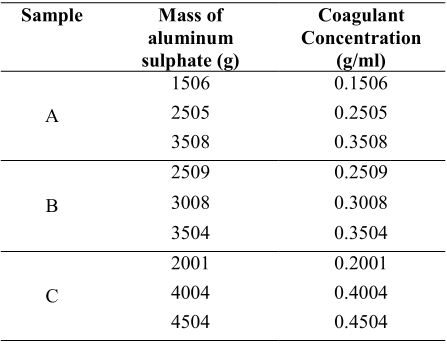
Table 1 Variation of the amount of aluminum sulphate added to the BL solution. 
Figure 4 IFT values from the formulation of surfactant mix at various ratios of SLS:PFAD:octanol. The effect of varying the amount of SLS and PFAD at a constant octanol weight of 8 wt% (a) and the effect of varying the amount of PFAD and octanol at a constant SLS weight of 70 wt% (b). 
Figure 3 Appearance of the lignin powder extracted from kraft black liquor (a) and SLS powder (b) 
Table 2 Variation of the amount of PAC added to the BL solution.


Citations
Carbon Black and Lignin Hybrid Filler in Designing NR Based Cushion Gum Composite Formulation
Santi Puspitasari,Adi Cifriadi +1 more
TL;DR: In this article , the performance of hybrid filler consisting of carbon black and lignin in affecting the physical and mechanical properties of natural rubber (NR) based cushion gum composite was carried out.
References
•Book
Modern Chemical Enhanced Oil Recovery: Theory and Practice
James J. Sheng
- 03 Nov 2010
TL;DR: In the field of chemical enhanced oil recovery (EOR), the recent developments in the area as well as the technology for enhancing oil recovery can be found in this article, where the authors provide a clear picture of fundamental concepts, underlying theoretical and modelling methods, operational parameters, solutions and sensitivity studies, and performance optimization strategies.
1K
•Book
Lignin and Lignans as Renewable Raw Materials: Chemistry, Technology and Applications
Francisco G. Calvo-Flores,José A. Dobado,Joaquín Isac-García,Francisco J. Martin-Martinez +3 more
- 28 Sep 2015
TL;DR: As naturally occurring and abundant sources of non-fossil carbon, lignin and lignans offer exciting possibilities as a source of commercially valuable products, moving away from petrochemical-based feedstocks in favour of renewable raw materials as discussed by the authors.
177
How to Attain an Ultralow Interfacial Tension and a Three-Phase Behavior with a Surfactant Formulation for Enhanced Oil Recovery: A Review. Part 2. Performance Improvement Trends from Winsor’s Premise to Currently Proposed Inter- and Intra-Molecular Mixtures
TL;DR: The minimum interfacial tension occurrence along a formulation scan at the so-called optimum formulation is discussed to be related to the interfacial curvature, but no accurate prediction is available.
An eco-friendly and efficient route of lignin extraction from black liquor and a lignin-based copolyester synthesis
Nguyen Dang Luong,Nguyen Dang Luong,Nguyen Thi Thanh Binh,Le Dai Duong,Dongouk Kim,Dae-Sik Kim,Seong Hoon Lee,Baek Jin Kim,Yong Sang Lee,Jae-Do Nam +9 more
TL;DR: Wang et al. as discussed by the authors developed an efficient process for the extraction of lignin from black liquor using a non-toxic aluminum potassium sulfate dodecahydrate (AlK(SO4)2·12H2O).
74
Synthesis and Physicochemical Investigation of Anionic–Nonionic Surfactants Based on Lignin for Application in Enhanced Oil Recovery
TL;DR: A series of eco-friendly anionic-nonionic surfactant lignin polyether sulfonates (LPES) based on alkali Lignin from the paper-making industry was prepared through alkoxylation, allylation and sulfonation as mentioned in this paper.
20