
Detecting dance motion structure through music analysis
Takaaki Shiratori,Atsushi Nakazawa,Katsushi Ikeuchi +2 more
- 17 May 2004
- pp 857-862
TL;DR: This work introduces musical information for motion structure analysis, which automatically detects the musical rhythm and segmments the original motion, an classifies them as to the primitive motions.
read more
Abstract: Currently, many important intangible cultural properties of the world are being lost because of the lack of successive performers. Digital archiving technology is one of the effective solutions for this issue, and we have started our digital archiving project of cultural properties including these intangible ones. For these human motion archives, the method of automatic motion structure analysis is vital for a variety of purposes. We believe that the dance motion consists of "primitive motions" and that motion analysis is necessary to detect these components. Particularly for dance motions, we think these primitives must be synchronized to the musical rhythm. In this work, we introduce musical information for motion structure analysis. This method automatically detects the musical rhythm and segmments the original motion, an classifies them as to the primitive motions. The experimental results confirm that our motion analysis yielded the primitive motions in accordance to the musical rhythm.
read more
Chat with Paper
AI Agents for this Paper
Find similar papers on Google Scholar, PubMed and Arxiv
Write a critical review of this paper
Analyze citations of this paper to find unaddressed research gaps
Figures
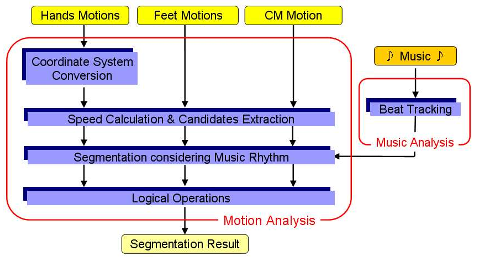
Figure 1: Algorithm Overview 
Figure 11: Segmentation result - Jongara-bushi 
Figure 10: Segmentation result - Aizu-bandaisan dance(male) 
Figure 9: Segmentation result - Aizu-bandaisan dance(female) 
Figure 2: Onset Component Extraction: Calculating how much power increases from ”PrevPow” 
Figure 4: Body Center Coordinate System


Citations
Producing stylized videos using the AnimVideo rendering tool
Rafael Beserra Gomes,Lucas M. Oliveira,Laurindo S. Britto-Neto,Tiago S. Santos,Gilbran S. Andrade,Bruno M. Carvalho,Luiz Marcos Garcia Gonçalves +6 more
TL;DR: The AnimVideo rendering tool that was developed for stylizing videos with temporal coherence is described, which provides the option of initializing the optical flow computation with displacement maps computed by homographies that map objects in adjacent frames.
370
Supervised pattern classification based on optimum-path forest
TL;DR: A general algorithm to learn from errors on an evaluation set without increasing the training set is proposed, and the advantages of the method with respect to SVM, ANN-MLP, and k-NN classifiers are shown in several experiments with datasets of various types.
Dancing-to-Music Character Animation
TL;DR: A new approach for synthesizing dance performance matched to input music, based on the emotional aspects of dance performance, which creates dance performance as if a character was listening and expressively dancing to the music.
166
DeepDance: Music-to-Dance Motion Choreography With Adversarial Learning
TL;DR: A GAN-based cross-modal association framework, DeepDance, which correlates two different modalities (dance motion and music) together, aiming at creating the desired dance sequence in terms of the input music, and is able to create long realistic dance sequences.
139
Humanoid Robot's Autonomous Acquisition of Proto-Symbols through Motion Segmentation
Wataru Takano,Yoshihiko Nakamura +1 more
- 01 Dec 2006
TL;DR: An automatic motion segmentation method utilizing correlation among movements for a short time period is proposed and it is shown that it is possible to acquire proto symbols by providing the automatically segmented motion patterns with the mimesis system.
91
References
The coordination of arm movements: an experimentally confirmed mathematical model.
Tamar Flash,Neville Hogan +1 more
TL;DR: A mathematical model is formulated which is shown to predict both the qualitative features and the quantitative details observed experimentally in planar, multijoint arm movements, and is successful only when formulated in terms of the motion of the hand in extracorporal space.
4.6K
Motion graphs
Lucas Kovar,Michael Gleicher,Frédéric Pighin +2 more
- 01 Jul 2002
TL;DR: This paper presents a novel method for creating realistic, controllable motion given a corpus of motion capture data, and presents a general framework for extracting particular graph walks that meet a user's specifications.
1.2K
Interactive control of avatars animated with human motion data
Jehee Lee,Jinxiang Chai,Paul S. A. Reitsma,Jessica K. Hodgins,Nancy S. Pollard +4 more
- 01 Jul 2002
TL;DR: This paper shows that a motion database can be preprocessed for flexibility in behavior and efficient search and exploited for real-time avatar control and demonstrates the flexibility of the approach through four different applications.
1K
Retargetting motion to new characters
Michael Gleicher
- 24 Jul 1998
TL;DR: In this article, a spacetime constraints solver computes an adapted motion that re-establishes these constraints while preserving the frequency characteristics of the original signal, and demonstrate their approach on motion capture data.
Motion signal processing
Armin Bruderlin,Lance Williams +1 more
- 15 Sep 1995
TL;DR: Multiresolution motion filtering, multitarget motion interpolation with dynamic timewarping, waveshaping and motion displacement mapping are introduced, complementary to keyframing, motion capture, and procedural animation.