
Journal Article10.61511/aes.v1i1.2023.42
Briefed on the development and progress of CCUS projects in China, USA, Western Europe, Russia, Norway, India, and Indonesia: a journal review
Rudianto Rimbono,Raldi Hendro Koestoer +1 more
TL;DR: The development and progress of CCUS projects in various countries are reviewed. China is leading in the development and implementation of CCUS technologies, followed by the USA, Europe, Russia, Norway, India, and Indonesia. Policy and government funding support, as well as non-traditional sources of capital, are needed to facilitate the implementation of CCUS technologies.
read more
Abstract: The global commitment to manage climate change issues is getting stronger and stronger. Therefore this review is carried out with the objective to obtain recent progress of efforts on emission control and handling through CCUS by various countries around the world. This review is carried out to highlight the development of carbon capture utilization and/or storage (CCUS) in China, the USA, and India, as these countries are known to be the most energy consumption countries. Its campaign to reduce emissions will contribute significantly to the effort of managing the global warming issue. The method used in this study is a literature review on the policies, studies, and projects mainly in China, and several other countries for comparison. The review found that although China is relatively late in doing such activities on climate change, but the progress is significantly faster than the others. The numbers of studies and patents are much higher than other countries, and the central and local governments issued a number of policies to help encourages the industries. The USA is known as one of the leading countries implementing CCS/CCUS and still creating incentive policies. European, Russian, and Indian countries pay serious attention to this effort and implement it while Indonesia as a non-industrial country is catching up.. From this literature research, it can be concluded that the technology for implementing CCUS is still at a high cost so policy and government funding support is needed as well as non-traditional sources of capital source such as green funding, carbon trading, etc.
read more
Chat with Paper
AI Agents for this Paper
Find similar papers on Google Scholar, PubMed and Arxiv
Write a critical review of this paper
Analyze citations of this paper to find unaddressed research gaps
Figures

Figure 1. Global Surface Temperature (Source: IPCC Working Group I Report, 2021) 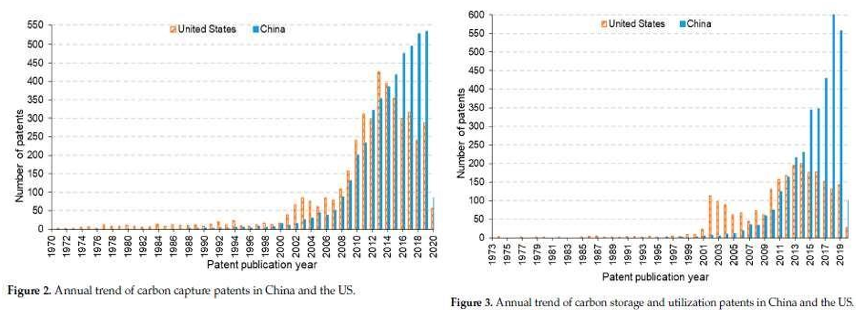
Figure 3. CCUS patent development in China and the US (Source: Li et al., 2022) 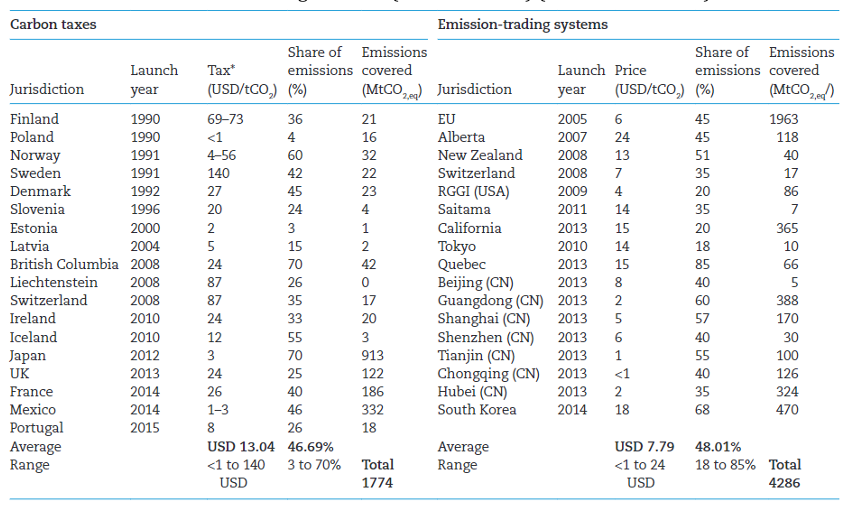
Table 1. Pricing and scale of existing carbon taxes and Emissions Trading Systems markets as of August 2017 (Ku et al., 2020) (Haites et al., 2018) 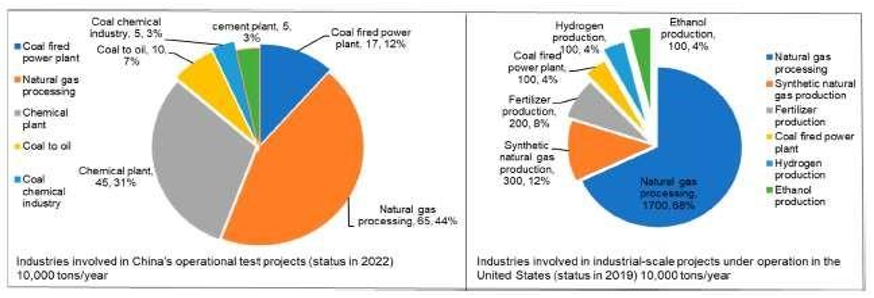
Figure 2. Development and application of CCUS in China and the USA (Source: Li et al., 2022)


References
The Sustainable Development Goals Report 2022
TL;DR: The sustainable development goals report 2022 as mentioned in this paper presents how far we have come towards reaching the 17 Sustainable Development Goals (SDGs) and also looks at the trends since 2015 and impact of COVID-19 on the progress.
A review of optimization and decision-making models for the planning of CO2 capture, utilization and storage (CCUS) systems
TL;DR: In this paper, the authors provide an in-depth discussion of the state-of-the-art of these tools, and also discuss recent developments on integrating CCUS components in large-scale planning.
335
Hard-to-Abate Sectors: The role of industrial carbon capture and storage (CCS) in emission mitigation
TL;DR: In this paper, the authors focus on CCS application in hard-to-abate sectors (cement industry, iron and steel, chemicals) and introduce industrial CCS options into the MIT Economic Projection and Policy Analysis (EPPA) model, a global multi-region multi-sector energyeconomic model that provides a basis for the analysis of long-term energy deployment.
192
The CCS hub in Norway: some insights from 22 years of saline aquifer storage
TL;DR: In this paper, the Sleipner and Snohvit CCS projects had captured and stored 22 Mt of CO2 in saline aquifers offshore Norway, with approximately one tenth of this volume dissolved in the brine phase.
93
Optimization of CCUS supply chains in the UK: A strategic role for emissions reduction
TL;DR: In this paper, three different carbon capture utilization and storage (CCUS) supply chains are developed giving economic indicators for CO2 utilization routes not implying carbon dioxide hydrogenation (i.e. with high TRL).