
All one needs to know about fog computing and related edge computing paradigms: A complete survey
Ashkan Yousefpour,Caleb Fung,Tam T. Nguyen,Krishna P. Kadiyala,Fatemeh Jalali,Amirreza Niakanlahiji,Jian Kong,Jason P. Jue +7 more
Chat with Paper
AI Agents for this Paper
Find similar papers on Google Scholar, PubMed and Arxiv
Write a critical review of this paper
Analyze citations of this paper to find unaddressed research gaps
Figures

Figure 8: Taxonomy of fog computing that is used in this survey. 
Figure 1: The structure of the survey. 
Figure 5: Fog brings several benefits for the application developers, applications, and different industries by distributing the core functions. 
Table 2: Attributes of fog-computing related paradigms 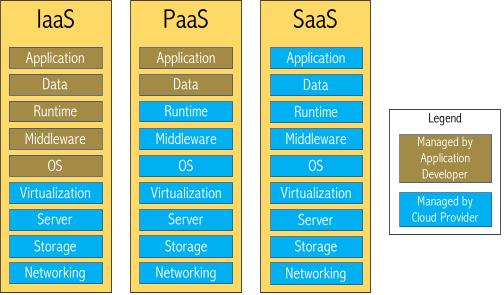
Figure 2: Common cloud service models and their classifications relative what portion of the application stack is managed by cloud providers. 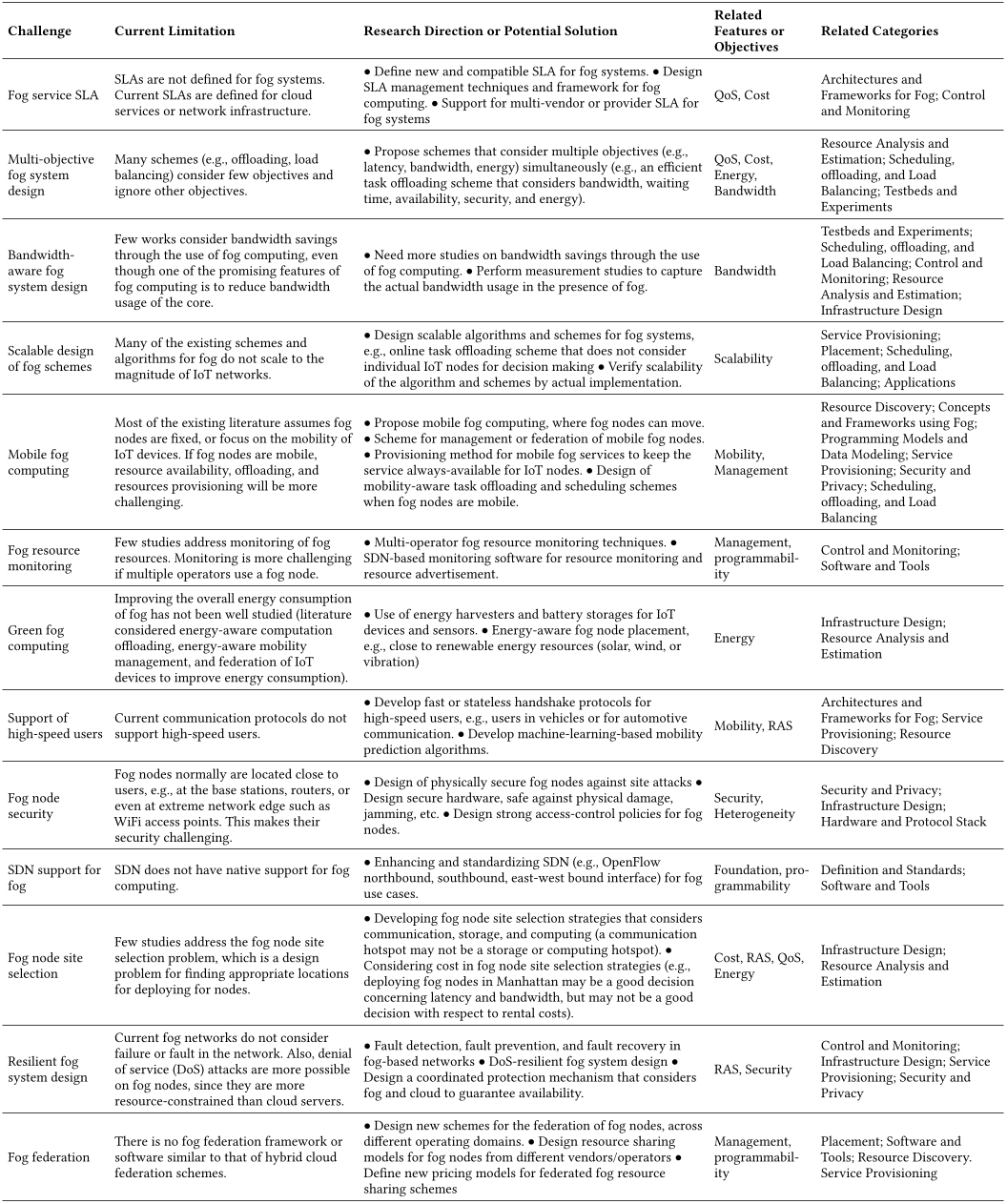
Table 7: Summary of challenges and future research directions


Citations
Reinforcement Learning Methods for Computing Offloading: A Systematic Review
TL;DR: In this paper , the authors provide a systematic review of the widely used reinforcement learning (RL) approaches in computation offloading, including both binary offloading and partial offloading techniques.
43
An Intelligent Edge-based Digital Twin for Robotics
Luigi Girletti,Milan Groshev,Carlos Guimaraes,Carlos J. Bernardos,Antonio de la Oliva +4 more
- 01 Dec 2020
TL;DR: In this paper, the authors proposed a solution for an edge-based Digital Twin for robotics, which leverages on the cloud-to-things continuum to offload computation and intelligence from the robots to the network.
Design and Simulation of a Hybrid Architecture for Edge Computing in 5G and Beyond
Hamed Rahimi,Yvan Picaud,kamal Deep Singh,Giyyarpuram Madhusudan,Salvatore Costanzo,Olivier Boissier +5 more
TL;DR: This paper deeply investigates Edge Computing in 5G and characterizes it based on the requirements of ultra-low latency applications and proposes a hybrid architecture that takes advantage of novel and sustainable technologies and has major features such as scalability, reliability, and ultra- low latency support.
43
Lightweight self-organising distributed monitoring of Fog infrastructures
TL;DR: FogMon is described, a C++ distributed monitoring prototype targeting Fog computing infrastructures that features a self-organising peer-to-peer topology with self-restructuring mechanisms, and differential monitoring updates, which ensure scalability, fault-tolerance and low communication overhead.
43
A Survey on Cloudlets, Mobile Edge, and Fog Computing
Manoj Muniswamaiah,Tilak Agerwala,Charles C. Tappert +2 more
- 26 Jun 2021
TL;DR: In this article, the authors proposed a solution to manage a massive volume of time-sensitive and security-critical data produced by the Internet of Things (IoT) by using fog computing, accompanied by the edge paradigms for computing such as cloudlet, mobile edge, and multi-access edge computing (MEC).
43
References
The NIST Definition of Cloud Computing
Peter Mell,Timothy Grance +1 more
- 28 Sep 2011
TL;DR: This cloud model promotes availability and is composed of five essential characteristics, three service models, and four deployment models.
17.6K
A view of cloud computing
Michael Armbrust,Armando Fox,Rean Griffith,Anthony D. Joseph,Randy H. Katz,Andy Konwinski,Gunho Lee,David A. Patterson,Ariel Rabkin,Ion Stoica,Matei Zaharia +10 more
TL;DR: The clouds are clearing the clouds away from the true potential and obstacles posed by this computing capability.
10.4K
Edge Computing: Vision and Challenges
TL;DR: The definition of edge computing is introduced, followed by several case studies, ranging from cloud offloading to smart home and city, as well as collaborative edge to materialize the concept of edge Computing.
7.1K
Fog computing and its role in the internet of things
Flavio Bonomi,Rodolfo A. Milito,Jiang Zhu,Sateesh Addepalli +3 more
- 17 Aug 2012
TL;DR: This paper argues that the above characteristics make the Fog the appropriate platform for a number of critical Internet of Things services and applications, namely, Connected Vehicle, Smart Grid, Smart Cities, and, in general, Wireless Sensors and Actuators Networks (WSANs).
A Survey on Mobile Edge Computing: The Communication Perspective
TL;DR: A comprehensive survey of the state-of-the-art MEC research with a focus on joint radio-and-computational resource management is provided in this paper, where a set of issues, challenges, and future research directions for MEC are discussed.
4.6K