
All one needs to know about fog computing and related edge computing paradigms: A complete survey
Ashkan Yousefpour,Caleb Fung,Tam T. Nguyen,Krishna P. Kadiyala,Fatemeh Jalali,Amirreza Niakanlahiji,Jian Kong,Jason P. Jue +7 more
Chat with Paper
AI Agents for this Paper
Find similar papers on Google Scholar, PubMed and Arxiv
Write a critical review of this paper
Analyze citations of this paper to find unaddressed research gaps
Figures

Figure 8: Taxonomy of fog computing that is used in this survey. 
Figure 1: The structure of the survey. 
Figure 5: Fog brings several benefits for the application developers, applications, and different industries by distributing the core functions. 
Table 2: Attributes of fog-computing related paradigms 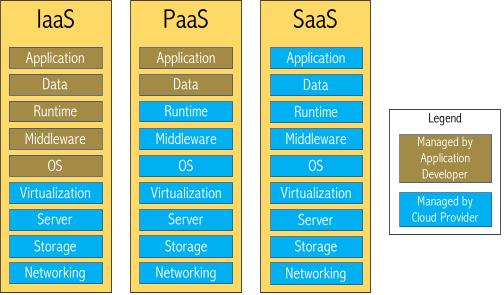
Figure 2: Common cloud service models and their classifications relative what portion of the application stack is managed by cloud providers. 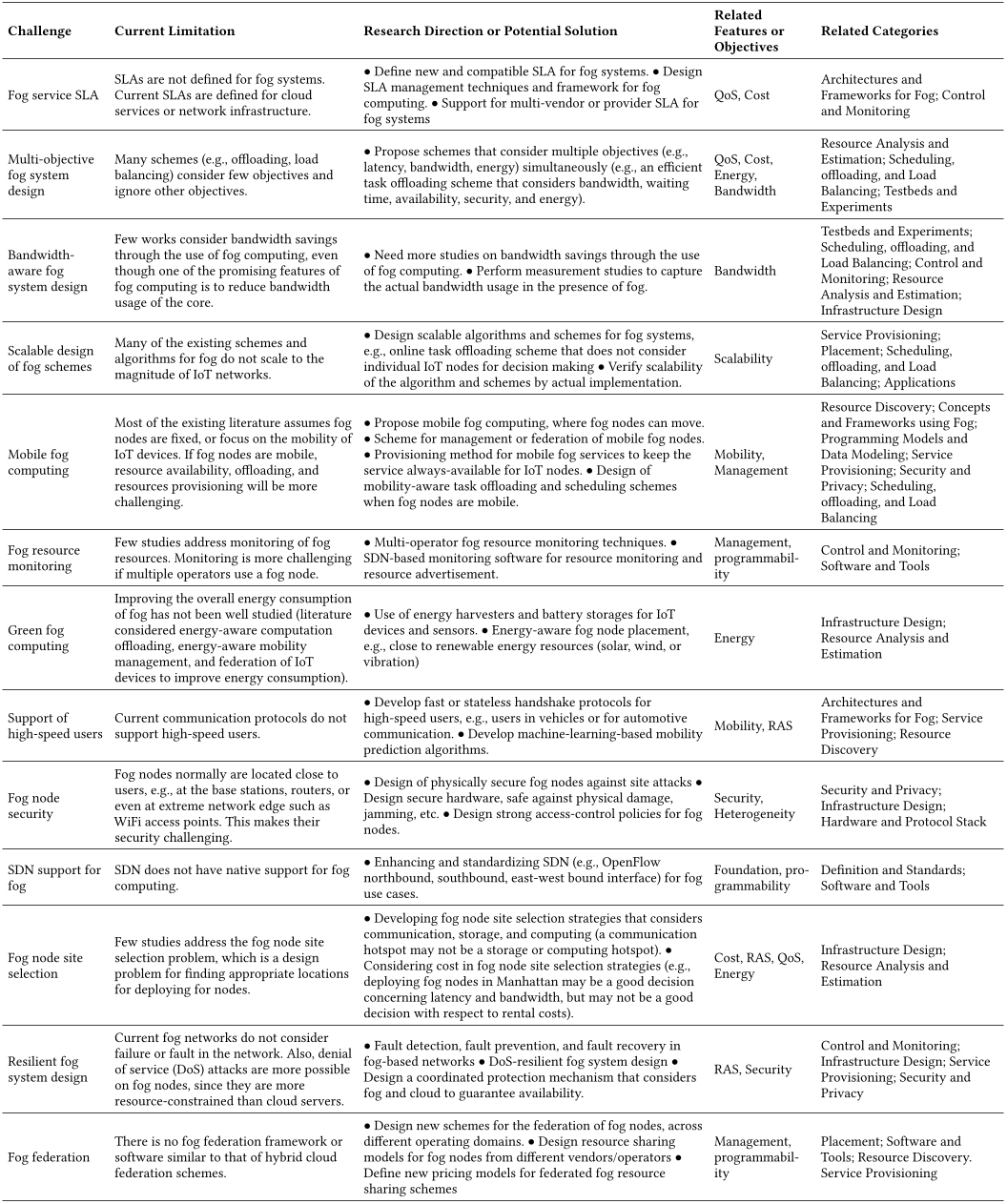
Table 7: Summary of challenges and future research directions


Citations
MiCADO-Edge: Towards an Application-level Orchestrator for the Cloud-to-Edge Computing Continuum
TL;DR: In this article, the authors present an application-level cloud orchestration framework called MiCADO-Edge, which can automatically deploy complex sets of interconnected microservices in such multi-layered cloud-to-edge environments.
Enabling the Orchestration of IoT Slices through Edge and Cloud Microservice Platforms
TL;DR: The architectural design of a slice orchestrator addressing the coordinated operation of entities at different infrastructures to support the automated orchestration of end-to-end Internet of Things services is presented, based on well-known standard technologies and protocols.
50
Authentication Techniques and Methodologies used in Wireless Body Area Networks
TL;DR: An overview of WBAN and their characteristics, various authentication types and classification of authentication schemes has been done, and a complete comparison of different authentication schemes is provided, which highlights their pros, cons, limitations, challenges, performance evaluation and their robustness against different security attacks.
49
Achieving Democracy in Edge Intelligence: A Fog-Based Collaborative Learning Scheme
TL;DR: A fog-based democratically collaborative learning scheme in which fog nodes collaborate on the model training process even without the support of the cloud, contributing to the advances of IoT in terms of realizing a more intelligent edge.
49
A Framework for the Joint Placement of Edge Service Infrastructure and User Plane Functions for 5G.
TL;DR: This paper introduces a framework to jointly address the placement of edge nodes (ENs) and UPFs and relies on Integer Linear Programming (ILP) and heuristic solutions to minimize overall costs while satisfying the service requirements.
49
References
The NIST Definition of Cloud Computing
Peter Mell,Timothy Grance +1 more
- 28 Sep 2011
TL;DR: This cloud model promotes availability and is composed of five essential characteristics, three service models, and four deployment models.
17.6K
A view of cloud computing
Michael Armbrust,Armando Fox,Rean Griffith,Anthony D. Joseph,Randy H. Katz,Andy Konwinski,Gunho Lee,David A. Patterson,Ariel Rabkin,Ion Stoica,Matei Zaharia +10 more
TL;DR: The clouds are clearing the clouds away from the true potential and obstacles posed by this computing capability.
10.4K
Edge Computing: Vision and Challenges
TL;DR: The definition of edge computing is introduced, followed by several case studies, ranging from cloud offloading to smart home and city, as well as collaborative edge to materialize the concept of edge Computing.
7.1K
Fog computing and its role in the internet of things
Flavio Bonomi,Rodolfo A. Milito,Jiang Zhu,Sateesh Addepalli +3 more
- 17 Aug 2012
TL;DR: This paper argues that the above characteristics make the Fog the appropriate platform for a number of critical Internet of Things services and applications, namely, Connected Vehicle, Smart Grid, Smart Cities, and, in general, Wireless Sensors and Actuators Networks (WSANs).
A Survey on Mobile Edge Computing: The Communication Perspective
TL;DR: A comprehensive survey of the state-of-the-art MEC research with a focus on joint radio-and-computational resource management is provided in this paper, where a set of issues, challenges, and future research directions for MEC are discussed.
4.6K