
All one needs to know about fog computing and related edge computing paradigms: A complete survey
Ashkan Yousefpour,Caleb Fung,Tam T. Nguyen,Krishna P. Kadiyala,Fatemeh Jalali,Amirreza Niakanlahiji,Jian Kong,Jason P. Jue +7 more
Chat with Paper
AI Agents for this Paper
Find similar papers on Google Scholar, PubMed and Arxiv
Write a critical review of this paper
Analyze citations of this paper to find unaddressed research gaps
Figures

Figure 8: Taxonomy of fog computing that is used in this survey. 
Figure 1: The structure of the survey. 
Figure 5: Fog brings several benefits for the application developers, applications, and different industries by distributing the core functions. 
Table 2: Attributes of fog-computing related paradigms 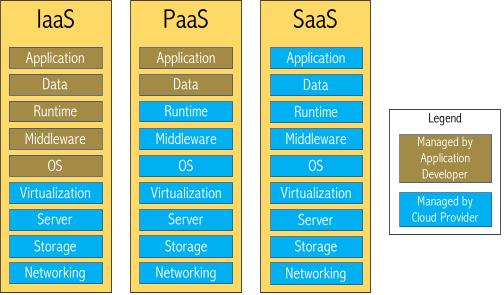
Figure 2: Common cloud service models and their classifications relative what portion of the application stack is managed by cloud providers. 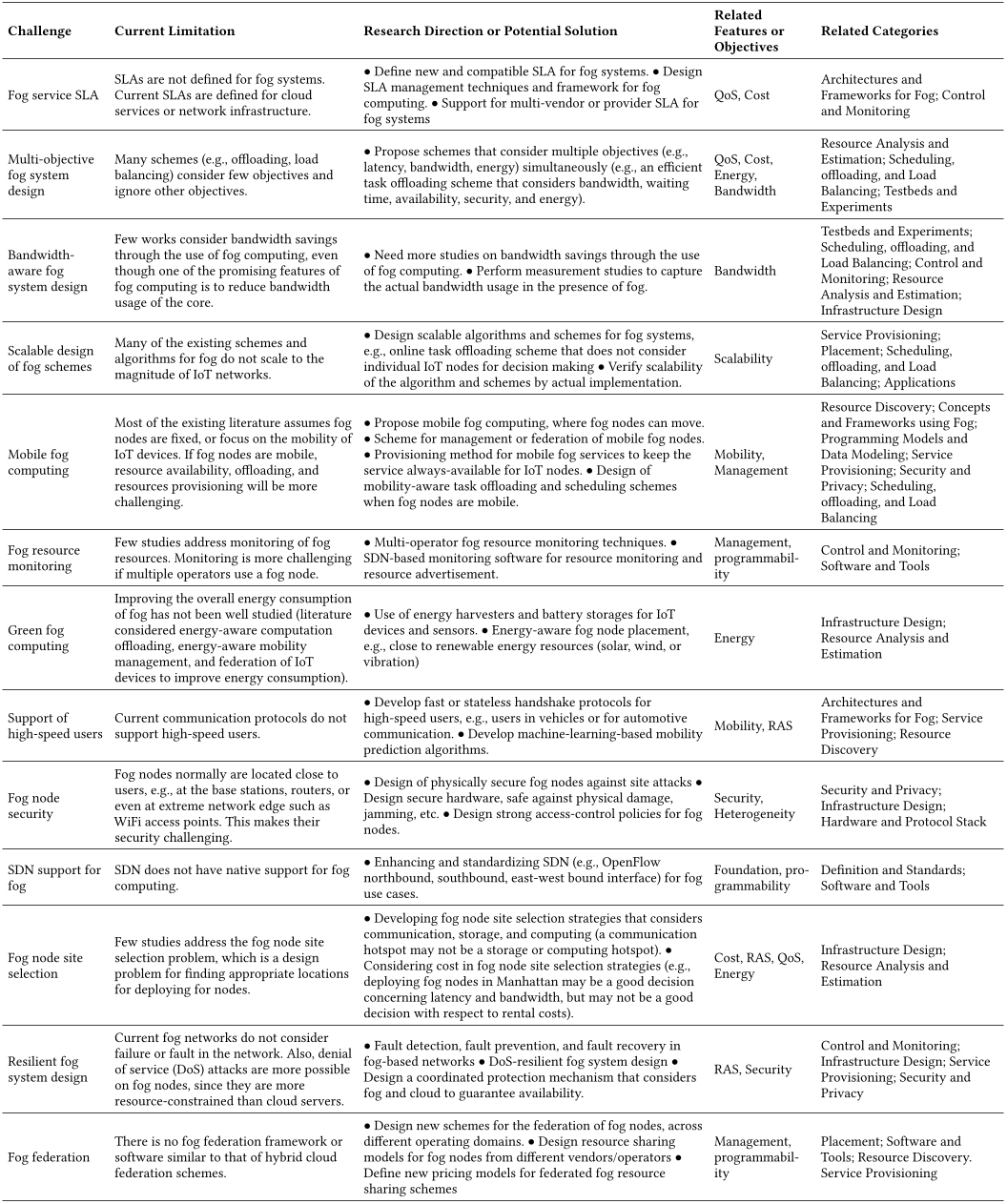
Table 7: Summary of challenges and future research directions


Citations
Towards effective offloading mechanisms in fog computing.
TL;DR: In this paper, the authors provide a systematic and comprehensive study to evaluate fog offloading mechanisms' current and recent works and state and address the present potentialities and issues of offloading in a fog environment efficiently.
A Survey on Blockchain-Fog Integration Approaches
Hamza Baniata,Attila Kertesz +1 more
TL;DR: This survey presents the up-to-date state-of-the-art of FC-BC integration with a detailed literature review and classification, and discusses and categorizes the related papers according to the year of publication, domain, used algorithms, BC roles, and the placement of the BC in the FC architecture.
Middleware for the Internet of Things: A survey on requirements, enabling technologies, and solutions
TL;DR: This survey discusses IoT middleware requirements and challenges, and presents the current state of research in this domain, and a technical taxonomy is presented according to the abstract and processing approach of data.
64
Fog computing approaches in IoT-enabled smart cities
TL;DR: In this article , the authors proposed a study for the state-of-the-art fog-based approaches in smart cities, which falls into three classes: service-based, resource-based and application-based.
63
•Posted Content
Multi-agent Reinforcement Learning for Resource Allocation in IoT networks with Edge Computing
Xiaolan Liu,Jiadong Yu,Yue Gao +2 more
TL;DR: A multi-agent reinforcement learning framework is developed to solve the game with the proposed Independent Learners based Multi-Agent Q-learning (IL-based MA-Q) algorithm, which has better system cost performance and achieves distributed computation offloading.
References
The NIST Definition of Cloud Computing
Peter Mell,Timothy Grance +1 more
- 28 Sep 2011
TL;DR: This cloud model promotes availability and is composed of five essential characteristics, three service models, and four deployment models.
17.6K
A view of cloud computing
Michael Armbrust,Armando Fox,Rean Griffith,Anthony D. Joseph,Randy H. Katz,Andy Konwinski,Gunho Lee,David A. Patterson,Ariel Rabkin,Ion Stoica,Matei Zaharia +10 more
TL;DR: The clouds are clearing the clouds away from the true potential and obstacles posed by this computing capability.
10.4K
Edge Computing: Vision and Challenges
TL;DR: The definition of edge computing is introduced, followed by several case studies, ranging from cloud offloading to smart home and city, as well as collaborative edge to materialize the concept of edge Computing.
7.1K
Fog computing and its role in the internet of things
Flavio Bonomi,Rodolfo A. Milito,Jiang Zhu,Sateesh Addepalli +3 more
- 17 Aug 2012
TL;DR: This paper argues that the above characteristics make the Fog the appropriate platform for a number of critical Internet of Things services and applications, namely, Connected Vehicle, Smart Grid, Smart Cities, and, in general, Wireless Sensors and Actuators Networks (WSANs).
A Survey on Mobile Edge Computing: The Communication Perspective
TL;DR: A comprehensive survey of the state-of-the-art MEC research with a focus on joint radio-and-computational resource management is provided in this paper, where a set of issues, challenges, and future research directions for MEC are discussed.
4.6K