
All one needs to know about fog computing and related edge computing paradigms: A complete survey
Ashkan Yousefpour,Caleb Fung,Tam T. Nguyen,Krishna P. Kadiyala,Fatemeh Jalali,Amirreza Niakanlahiji,Jian Kong,Jason P. Jue +7 more
Chat with Paper
AI Agents for this Paper
Find similar papers on Google Scholar, PubMed and Arxiv
Write a critical review of this paper
Analyze citations of this paper to find unaddressed research gaps
Figures

Figure 8: Taxonomy of fog computing that is used in this survey. 
Figure 1: The structure of the survey. 
Figure 5: Fog brings several benefits for the application developers, applications, and different industries by distributing the core functions. 
Table 2: Attributes of fog-computing related paradigms 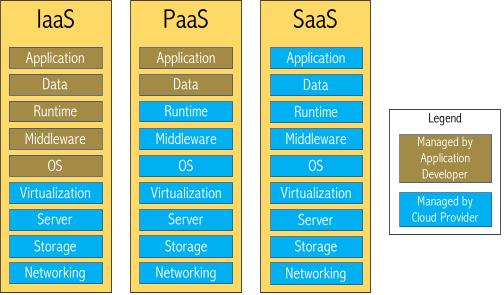
Figure 2: Common cloud service models and their classifications relative what portion of the application stack is managed by cloud providers. 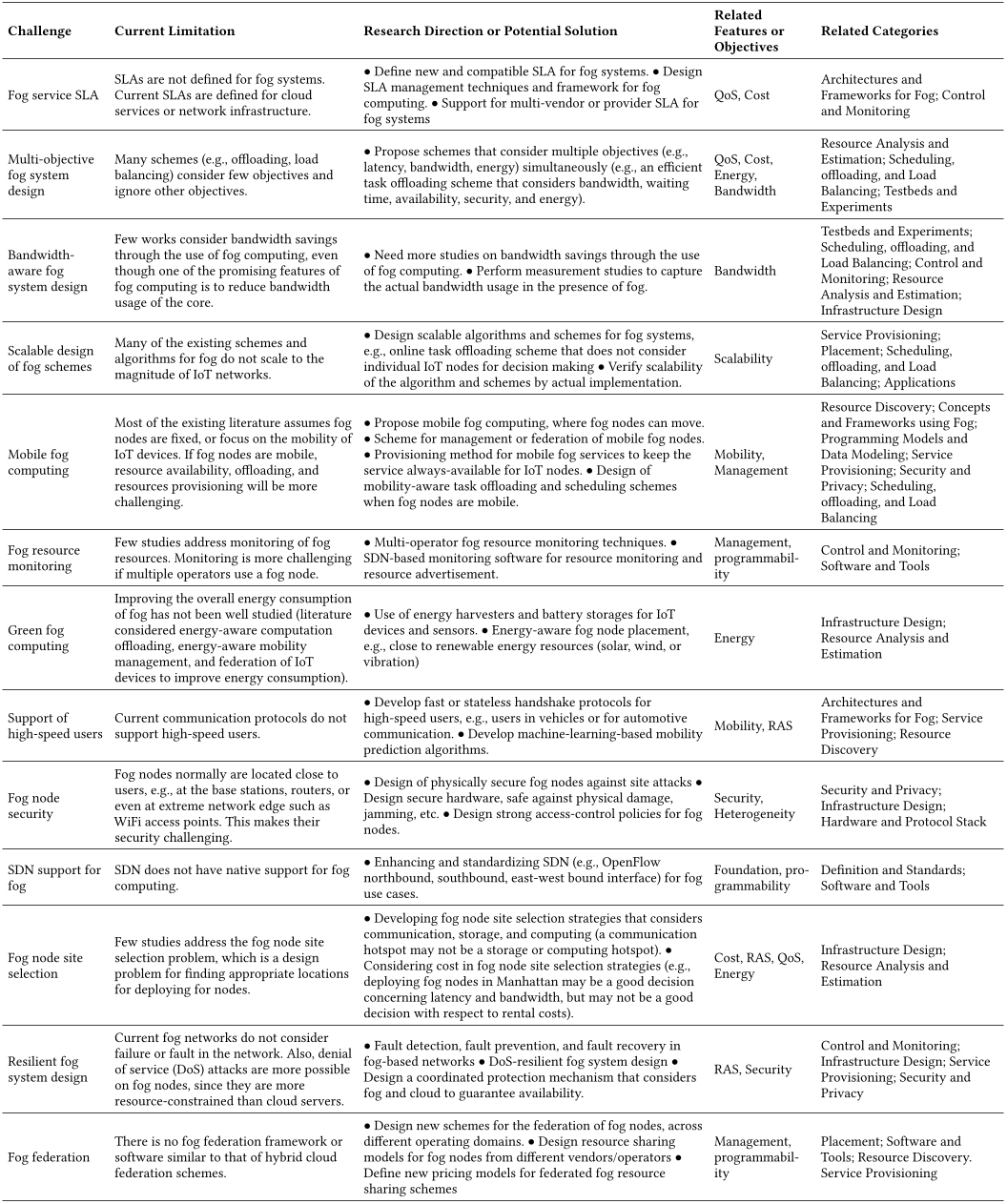
Table 7: Summary of challenges and future research directions


Citations
Mapping IoT Applications on the Edge to Cloud Continuum with a Filter Stream Model
Shuangsheng Lou,Gagan Agrawal +1 more
- 10 May 2021
TL;DR: In this paper, the authors present a framework for automated deployment of streaming applications for IoT (or edge computing) environments with an emphasis on optimizing latency in the presence of resource constraints.
Management of split intersections using vehicular visible light communication
Manuela Vieira,Paula Louro,Pedro Vieira +2 more
- 04 Mar 2022
TL;DR: A Visible Light Communication system that can safely manage vehicles crossing an intersection using Edge of Things facilities is proposed and results show that the short-range mesh network ensures a secure communication from street lamp controllers to the edge computer through the neighbor traffic light controller with active cellular connection.
UMLsec4Edge: Extending UMLsec to model data-protection-compliant edge computing systems
Sven Smolka,Jan Laufer,Zoltán Ádám Mann,Klaus Pohl +3 more
- 01 Aug 2022
TL;DR: The aim of this paper is to create a modeling language which meets all requirements concerning the design of the architecture of edge computing systems accounting for data protection, and extends UMLsec to satisfy all requirements.
Latency-aware Resource Management at the Edge
Klervie Toczé
- 24 Mar 2020
TL;DR: The increasing diversity of connected devices leads to new application domains being envisioned and some of these need ultra low latency or have privacy requirements that cannot be satisfied by the current standards.
A Toolchain and Interoperability Framework to enhance privacy and individual control at the Edge
Panagiotis Katrakazas,Theodora Kallinolitou,Stella Markopoulou,Argyro Chronopoulou +3 more
- 26 Sep 2022
TL;DR: In this paper , the authors present five key pillars of innovation towards privacy-preserving edge computing, regarding smart sampling of IoT devices, anonymous authentication and consent management, dynamic data-driven pattern management, opportunistic IoT clustering, distributed IoT data governance, and resource integrity validation.
References
The NIST Definition of Cloud Computing
Peter Mell,Timothy Grance +1 more
- 28 Sep 2011
TL;DR: This cloud model promotes availability and is composed of five essential characteristics, three service models, and four deployment models.
17.6K
A view of cloud computing
Michael Armbrust,Armando Fox,Rean Griffith,Anthony D. Joseph,Randy H. Katz,Andy Konwinski,Gunho Lee,David A. Patterson,Ariel Rabkin,Ion Stoica,Matei Zaharia +10 more
TL;DR: The clouds are clearing the clouds away from the true potential and obstacles posed by this computing capability.
10.4K
Edge Computing: Vision and Challenges
TL;DR: The definition of edge computing is introduced, followed by several case studies, ranging from cloud offloading to smart home and city, as well as collaborative edge to materialize the concept of edge Computing.
7.1K
Fog computing and its role in the internet of things
Flavio Bonomi,Rodolfo A. Milito,Jiang Zhu,Sateesh Addepalli +3 more
- 17 Aug 2012
TL;DR: This paper argues that the above characteristics make the Fog the appropriate platform for a number of critical Internet of Things services and applications, namely, Connected Vehicle, Smart Grid, Smart Cities, and, in general, Wireless Sensors and Actuators Networks (WSANs).
A Survey on Mobile Edge Computing: The Communication Perspective
TL;DR: A comprehensive survey of the state-of-the-art MEC research with a focus on joint radio-and-computational resource management is provided in this paper, where a set of issues, challenges, and future research directions for MEC are discussed.
4.6K