
All one needs to know about fog computing and related edge computing paradigms: A complete survey
Ashkan Yousefpour,Caleb Fung,Tam T. Nguyen,Krishna P. Kadiyala,Fatemeh Jalali,Amirreza Niakanlahiji,Jian Kong,Jason P. Jue +7 more
Chat with Paper
AI Agents for this Paper
Find similar papers on Google Scholar, PubMed and Arxiv
Write a critical review of this paper
Analyze citations of this paper to find unaddressed research gaps
Figures

Figure 8: Taxonomy of fog computing that is used in this survey. 
Figure 1: The structure of the survey. 
Figure 5: Fog brings several benefits for the application developers, applications, and different industries by distributing the core functions. 
Table 2: Attributes of fog-computing related paradigms 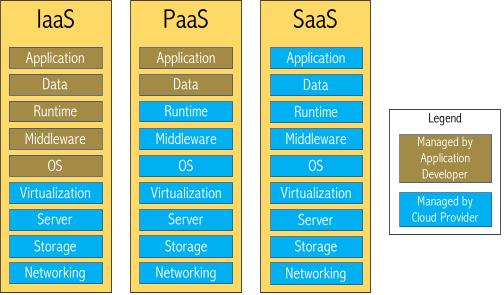
Figure 2: Common cloud service models and their classifications relative what portion of the application stack is managed by cloud providers. 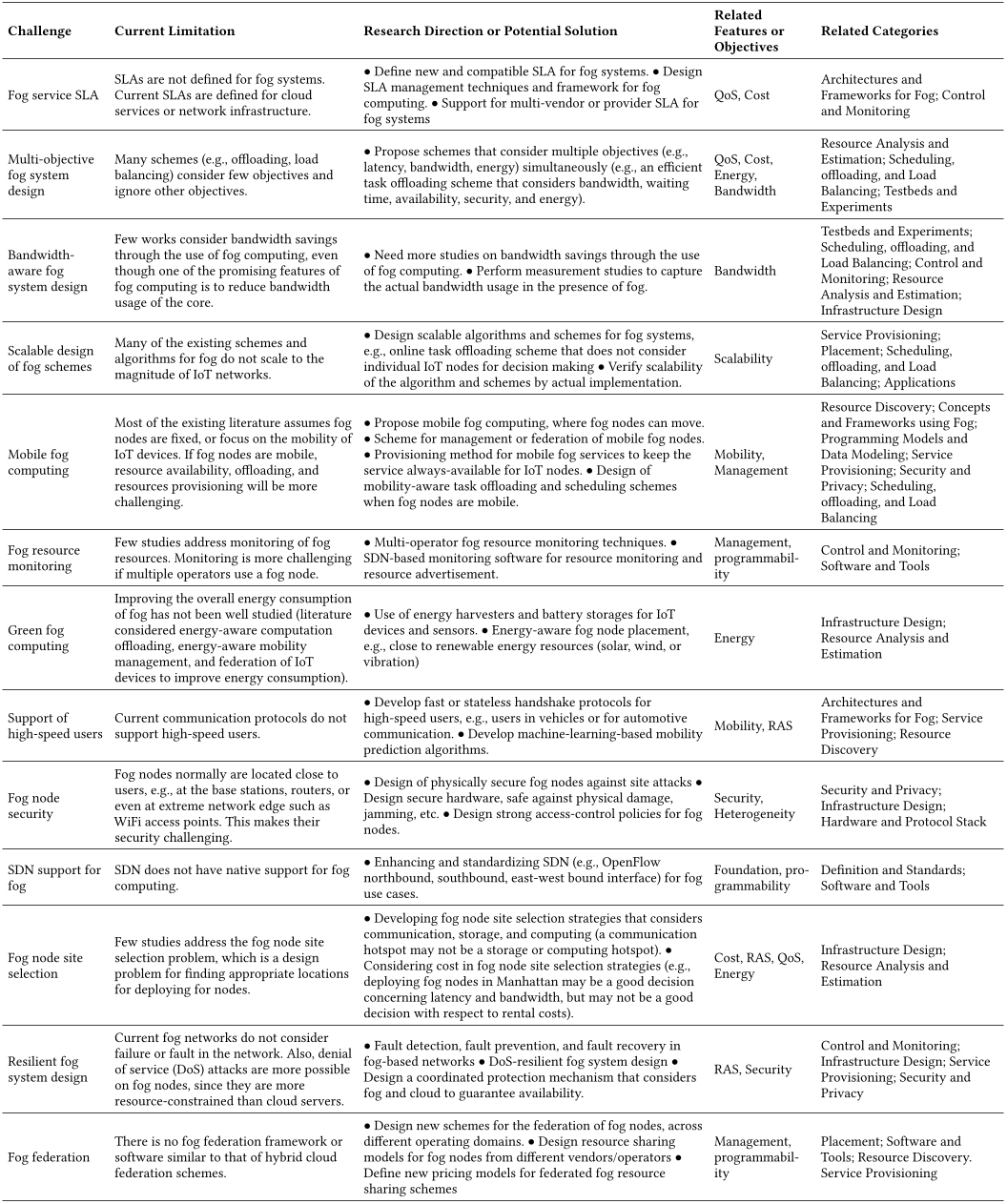
Table 7: Summary of challenges and future research directions


Citations
Extending Service-oriented Architectures in Manufacturing towards Fog and Edge Levels
David Albert Breunig,Alain Roedel,Thomas Bauernhansl +2 more
- 20 Jul 2020
TL;DR: In this paper, the authors present an extension of an existing event-driven SoA platform to realize locally deployable protocol-independent and portable communication and integration workflows at the edge of the manufacturing cloud.
Design and Implementation of Fragmented Clouds for Evaluation of Distributed Databases
TL;DR: A layered FHC that leverages Linux utilities and bash-shell programming is implemented that provides deep insights into the performance of well-known big data databases, such as Cassandra, MongoDB, Redis, and MySQL, when deployed on a FHC.
Journal Article
SimulateIoT-Federations: Domain Specific Language for designing and executing IoT simulation environments with Fog and Fog-Cloud federations (Poster)
TL;DR: In this article , the authors present a latency simulator for the Internet of Things (IoT), where the end-user can model the maximum and minimum latency, as well as the latency distribution (e.g. Gaussian) that each of the nodes might experience when interacting with each other.
Fog Computing or Cloud Computing: a Study
Asma N. Elmoghrapi,Ahmed Bleblo,Younis A. Younis +2 more
- 04 Jul 2022
TL;DR: The concepts of cloud computing and fog computing will be explored in this paper, and their features will be contrasted to determine the differences between them.
Distributed Computing Architecture for Logistic Job Allocation in Smart Factory
Philip Tobianto Daely,Alifia Putri Anantha,Jae-Min Lee,Dong-Seong Kim +3 more
- 21 Oct 2020
TL;DR: In this paper, an architecture that utilizes edge servers to allocate logistic jobs to autonomous guided vehicles (AGV) in smart factory setting is proposed, which can reduce computation load at main server when utilizing edge servers and the number of AGVs can be adjusted to achieve better job allocation and execution performance.
References
The NIST Definition of Cloud Computing
Peter Mell,Timothy Grance +1 more
- 28 Sep 2011
TL;DR: This cloud model promotes availability and is composed of five essential characteristics, three service models, and four deployment models.
17.6K
A view of cloud computing
Michael Armbrust,Armando Fox,Rean Griffith,Anthony D. Joseph,Randy H. Katz,Andy Konwinski,Gunho Lee,David A. Patterson,Ariel Rabkin,Ion Stoica,Matei Zaharia +10 more
TL;DR: The clouds are clearing the clouds away from the true potential and obstacles posed by this computing capability.
10.4K
Edge Computing: Vision and Challenges
TL;DR: The definition of edge computing is introduced, followed by several case studies, ranging from cloud offloading to smart home and city, as well as collaborative edge to materialize the concept of edge Computing.
7.1K
Fog computing and its role in the internet of things
Flavio Bonomi,Rodolfo A. Milito,Jiang Zhu,Sateesh Addepalli +3 more
- 17 Aug 2012
TL;DR: This paper argues that the above characteristics make the Fog the appropriate platform for a number of critical Internet of Things services and applications, namely, Connected Vehicle, Smart Grid, Smart Cities, and, in general, Wireless Sensors and Actuators Networks (WSANs).
A Survey on Mobile Edge Computing: The Communication Perspective
TL;DR: A comprehensive survey of the state-of-the-art MEC research with a focus on joint radio-and-computational resource management is provided in this paper, where a set of issues, challenges, and future research directions for MEC are discussed.
4.6K