Using AI for Research: A Practical Guide and 10 Tools
Using AI for research in current times, where the research landscape is evolving at an unprecedented rate, can be a game changer. Artificial intelligence can assist, augment, and even revolutionize the way we discover, conduct, and write scientific research.
Artificial intelligence is changing how researchers discover information, work with data, read academic papers, and communicate their findings. What began primarily as a tool for generating and editing text has expanded into a much broader set of research applications.
Using AI for research is no different, particularly in current times where the research landscape is evolving at an unprecedented rate. New scientific domains are sprouting frequently, millions of papers are being published every year, and there are vast amounts of data needing to be synthesized.
The key is to treat AI as a research assistant rather than an authority: use it to accelerate tasks, but keep human judgment, verification, and responsibility at the center of the research process.
How can you use AI for research?
AI has proven itself to be handy in many professional circumstances. In academic research, you can easily fit it into several stages of your workflow. Here are some of the ways you can use it:
Finding and reviewing relevant papers
A literature review can involve searching across large numbers of papers, screening results, identifying relevant studies, and synthesizing findings. AI-powered research tools can help with several of these tasks by identifying papers based on concepts and relationships rather than relying exclusively on exact keyword matches.
There are AI search engines in plenty that comb through vast databases of research papers, identify relevant papers, and even summarize key findings. This can help you speed up paper analysis, find trends or gaps in the literature, and discover a research question faster.
Most of these AI research assistants and ChatPDF tools help you discover new research articles based on a more accurate semantic search. Even if you don’t have the right keyword, you will still be able to find the correct papers.
Comprehending academic papers
AI can make academic papers easier to read and understand by simplifying jargon and complex topics in research papers. They can also summarise long papers into shorter reads so that you save quite some time while going through heaps of scientific articles.
Some AI assistants let you interact with papers, meaning you can essentially have a conversation with the PDF you’re reading. You can enter prompts like a simple question to get an answer or even ask to create a presentation. The AI tool will read the paper and give the output.
Academic AI tools are also alleviating language barriers by allowing users to do the above task in their native languages.
Data collection and analysis
AI can automate data collection processes by quickly gathering information by mining large databases. Even more impressive is when AI starts analyzing this huge data.
For humans, it would be unfathomable to go through a mountain of data, uncovering patterns, trends, and correlations. However, for AI tools, it’s a rather easy process with less room for error.
Whether it’s data entry or data analysis, manually working with data can be an uphill task. Through AI, you will be able to arrive at more accurate insights faster, which sets a high-quality foundation for your research.
Better academic writing
Language models can assist in better writing regardless of your comprehension skill.
They can help with accurate citations, along with providing grammar and style suggestions as you are writing your paper or essay. This means you can now automate proofreading and creating citations.
AI also solves the problem of stiff scientific writing. Tools like paraphrasers and co-writers give you a great opportunity to instantly improve your writing skills and convey your thoughts in the way you actually wish.
Seamless team collaborations
AI can significantly enhance group projects where collaboration and communication are of focus. Through project management research tools, you can automate tedious tasks, manage documents better, and facilitate better communication by creating common workspaces online.
If you’re working with people from different linguistic backgrounds, AI can help you translate in real-time while you’re on calls.
Instant plagiarism checks
Maintaining academic integrity is a non-negotiable while submitting papers. AI tools can help detect plagiarism or the presence of AI in your writing. These tools scan your work, compare it to an extensive database of academic and online content, and flag potential instances of plagiarism.
Similarly, AI detectors recognize the pattern that AI writing follows and proceed to highlight any instances of such writing in your prose.
These ten examples serve different research tasks and are not a quality ranking. Confirm current access and features on each product site, then inspect original sources before citing an AI output.
AI tools for research workflows
Combine the importance of AI in modern-day research life with this huge wave of generative AI and ChatGPT in the past couple of years, it should come as no surprise that there is a host of extremely helpful AI tools for research.
Here are 5 best AI tools for researchers which can be integrated to your workflow:
SciSpace
SciSpace is an AI-powered research platform designed to help researchers discover, understand, and work with scientific literature.
Its current platform includes tools for literature search and review, Chat with PDF, citation generation, writing, and other research workflows. SciSpace's research repository currently lists 200 million+ research papers, alongside access to 50 million+ open-access full-text PDFs.
SciSpace combines semantic and text-based search, with its current search documentation describing sources including OpenAlex, Semantic Scholar, Google Scholar, and other repositories.
Its document tools can also help researchers ask questions about individual papers, explain complex sections, and extract information from research documents.
Best for: Discovering, understanding, and synthesizing academic literature in one research workflow.
SciSpace
Litmaps
Litmaps is a literature discovery and citation-mapping tool that helps researchers explore relationships between academic papers.
Citation mapping can be useful when a keyword search has already identified a few important papers and you want to discover earlier foundational studies or newer research connected to them.
Best for: Exploring citation networks and finding related literature.
Litmaps
Endnote
EndNote is a reference managing tool that assists you in sorting your bibliographies and references while writing essays, reports, and journal articles. It allows you to create a personal database of references and files, as well as insert references into a Word document and automatically format them in your preferred citation style.
Best for: Managing references, citations, and bibliographies.
EndNote
Notion
Notion is a general-purpose workspace for organizing notes, documents, databases, tasks, and projects. For researchers, it can be used to maintain literature notes, research logs, project documentation, meeting notes, and collaborative workspaces.
Best for: Research notes, project organization, and team collaboration.
Notion
Otter.ai
Otter.ai is a boon while you’re in meetings or recording audio while you work. The AI tool automatically transcribes everything you’re saying and generates live captions during meetings. You can also connect Otter.ai with popular meeting apps like Zoom or Google Meet.
Best for: Transcription and organizing spoken research material.
Otter.ai
Elicit
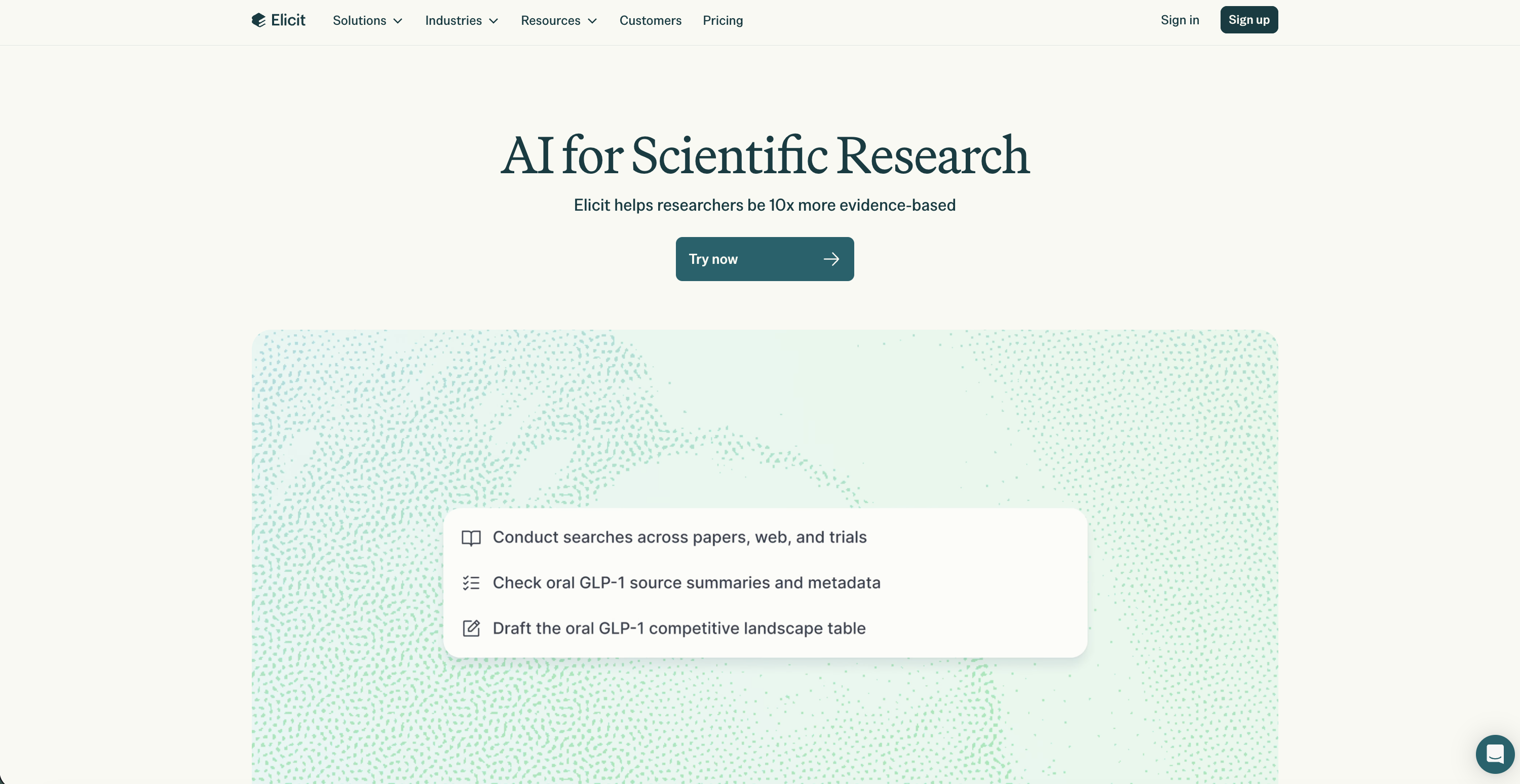
Elicit is an AI research tool designed to help researchers search academic papers and organize evidence around research questions.
Its current search product says it searches more than 138 million academic papers and conference proceedings, alongside other research sources such as clinical trials.
Best for: Searching for papers and organizing evidence around a research question.
Rayyan
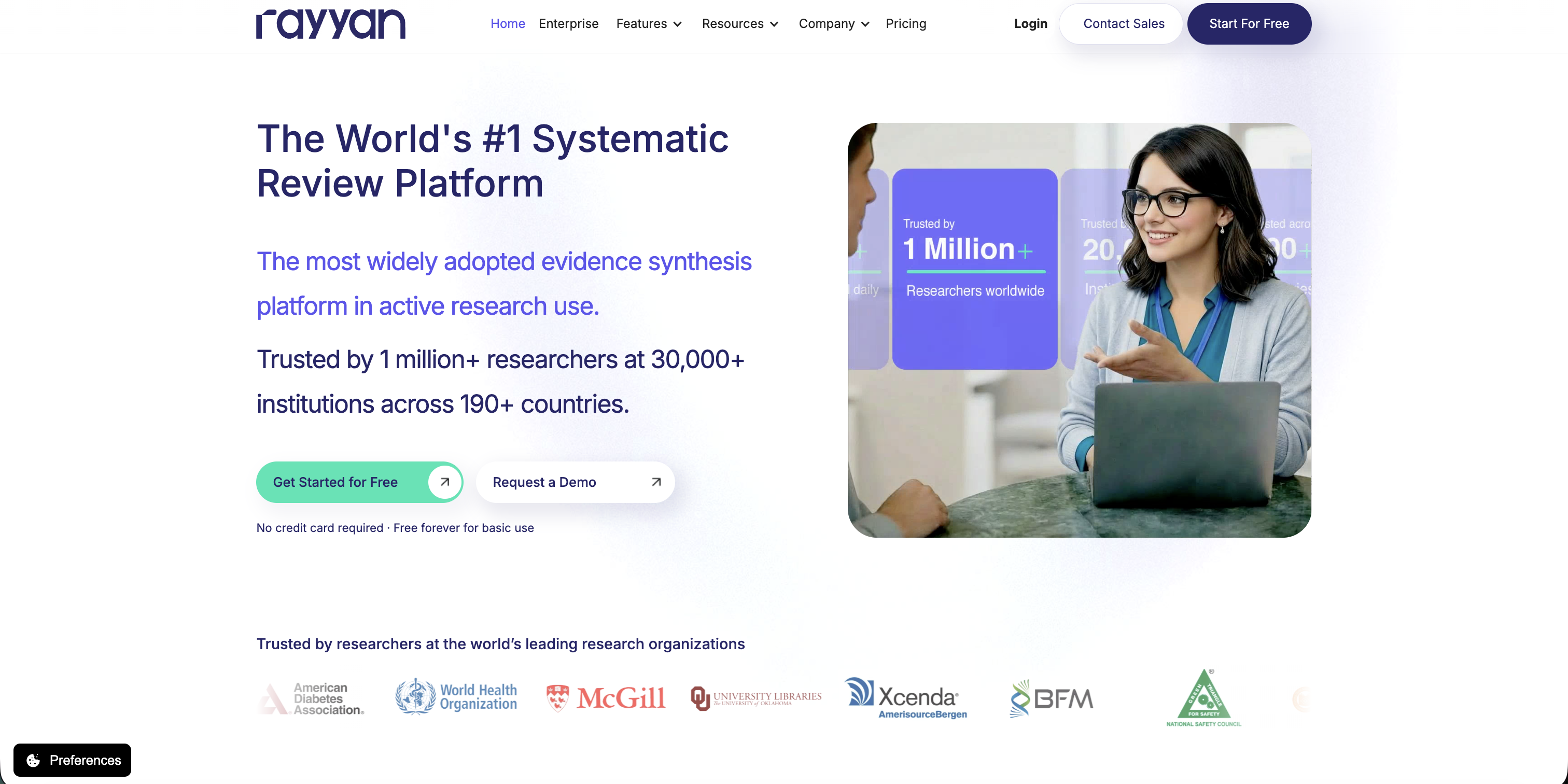
Rayyan is designed to help researchers organize and screen references, particularly for literature reviews and evidence-synthesis projects.
Its current workflow supports stages including title and abstract screening, full-text screening, data extraction, and risk-of-bias assessment.
Best for: Screening and organizing studies for literature reviews and evidence synthesis.
Scholarcy
Scholarcy generates structured summaries of research papers and other documents. This can help researchers get an initial overview of a paper before deciding which sections require closer reading.
Best for: Quickly getting an initial structured overview of academic papers.
Zotero
Zotero is a reference-management tool that helps researchers collect, organize, annotate, and cite sources.
It can be particularly useful for maintaining a searchable research library throughout a long-term project.
Best for: Collecting, organizing, and citing research sources.
ResearchRabbit
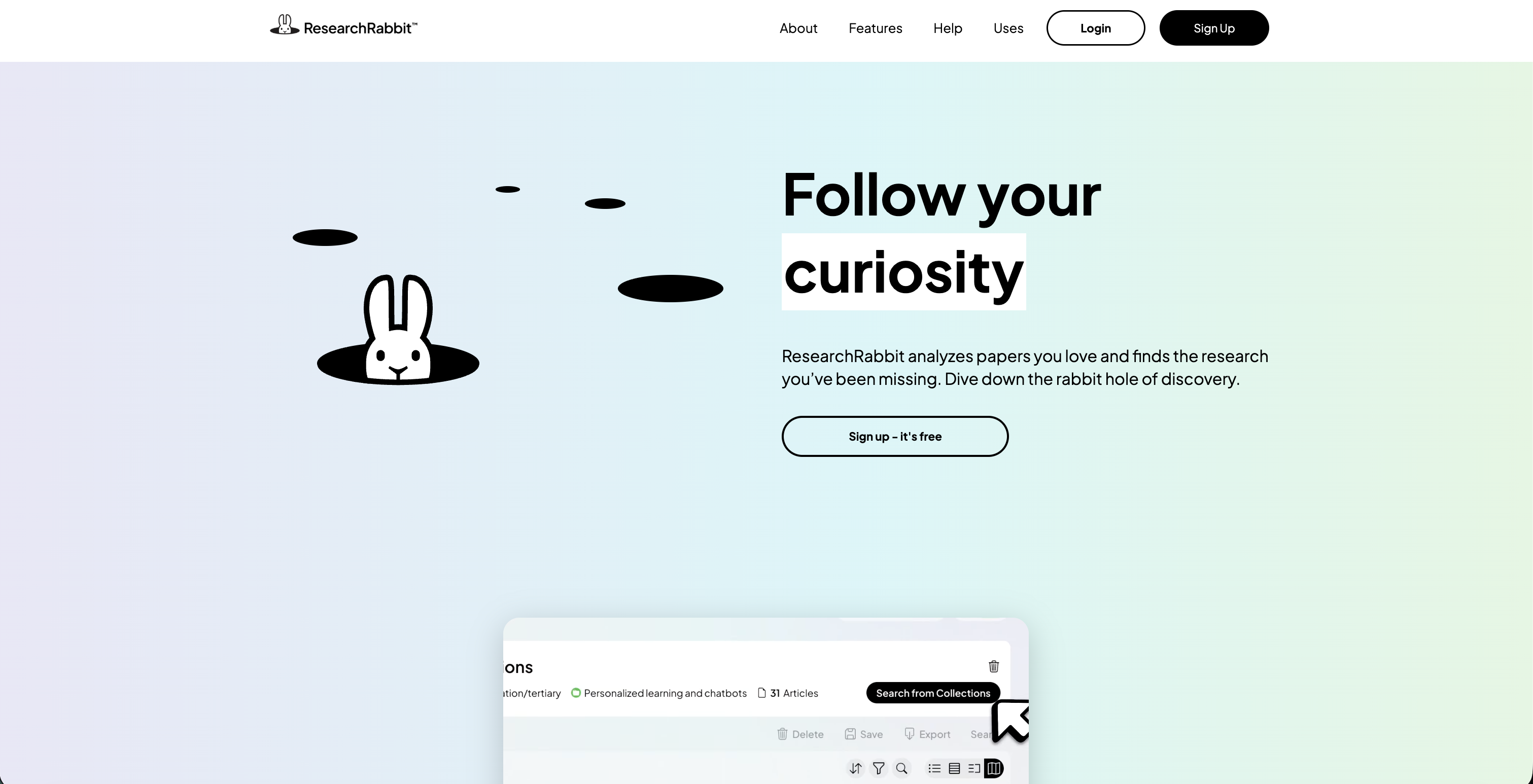
ResearchRabbit helps researchers discover related academic papers and authors through connections between research publications.
This can be useful when you already have a few relevant papers and want to expand your search through related research rather than relying only on keyword queries.
Best for: Exploring related papers, authors, and research networks.
Best practices while using AI for academic research
While AI is predominantly a boon for researchers, all things have their pros and cons. AI is still a technology in its infancy, as experts call it, and it should be treated as such.
So before you become completely dependent on it, here are a few things you should keep in mind while using an AI-powered research tool:
Ensure data quality and bias
Before you start to analyze data using AI, take a moment to consider the quality of your input. Because if you feed low-quality data to a machine, you can't expect a high-quality output. That just isn’t how it works.
AI cannot think for itself in the same way humans do. At best, it can learn from everything it has been fed and predict an output. So, make sure your data is premium, representative, and, most importantly, unbiased. Biased data can lead to skewed results and questionable conclusions.
Adhere to academic ethics
To reiterate again, academic researchers are bound by academic integrity. Plagiarism, AI-assisted writing, and privacy regulations are all of the highest priority while publishing a paper.
Thus, it’s always better to ensure your research complies with ethical standards and you use necessary plagiarism and AI detection tools before submitting your paper. How you write a paper is a reflection of who you are as a professional.
Check for hallucinations
While AI may seem perfect at all times, it has its moments that make you question the validity of the entire technology.
Sometimes, AI systems can generate results that seem plausible but are entirely incorrect or generate complete gibberish. There are also times when an AI might give you the correct answer but fake its sources. This is popularly known as a hallucination.
It’s quite obvious how it can be detrimental to your academic research, thus it’s always better to fact-check AI-generated output. Some AI assistants have real citations in their answers now, which helps build trust.
Maintain human oversight
While AI can automate and streamline many tasks, it can't replace human judgment, context, and expertise. And given how AI can, at times, hallucinate or give false output, it’s always better to have your human judgment review everything.
Keep a Record of How You Used AI
For substantial AI use, keeping a simple record of your workflow can make it easier to explain and reproduce your research process. This is particularly useful when AI is part of the research methodology rather than simply being used for language editing.
To leave you with
The academic world has changed significantly with the emergence of AI-powered research tools. Researchers can now use AI to search literature, understand complex papers, organize evidence, process data, generate research questions, and improve academic writing.
As AI research tools continue to develop, researchers will likely have more opportunities to automate parts of the research workflow. The fundamental responsibility, however, remains the same: know your sources, verify your evidence, protect your data, and take responsibility for the work you publish.