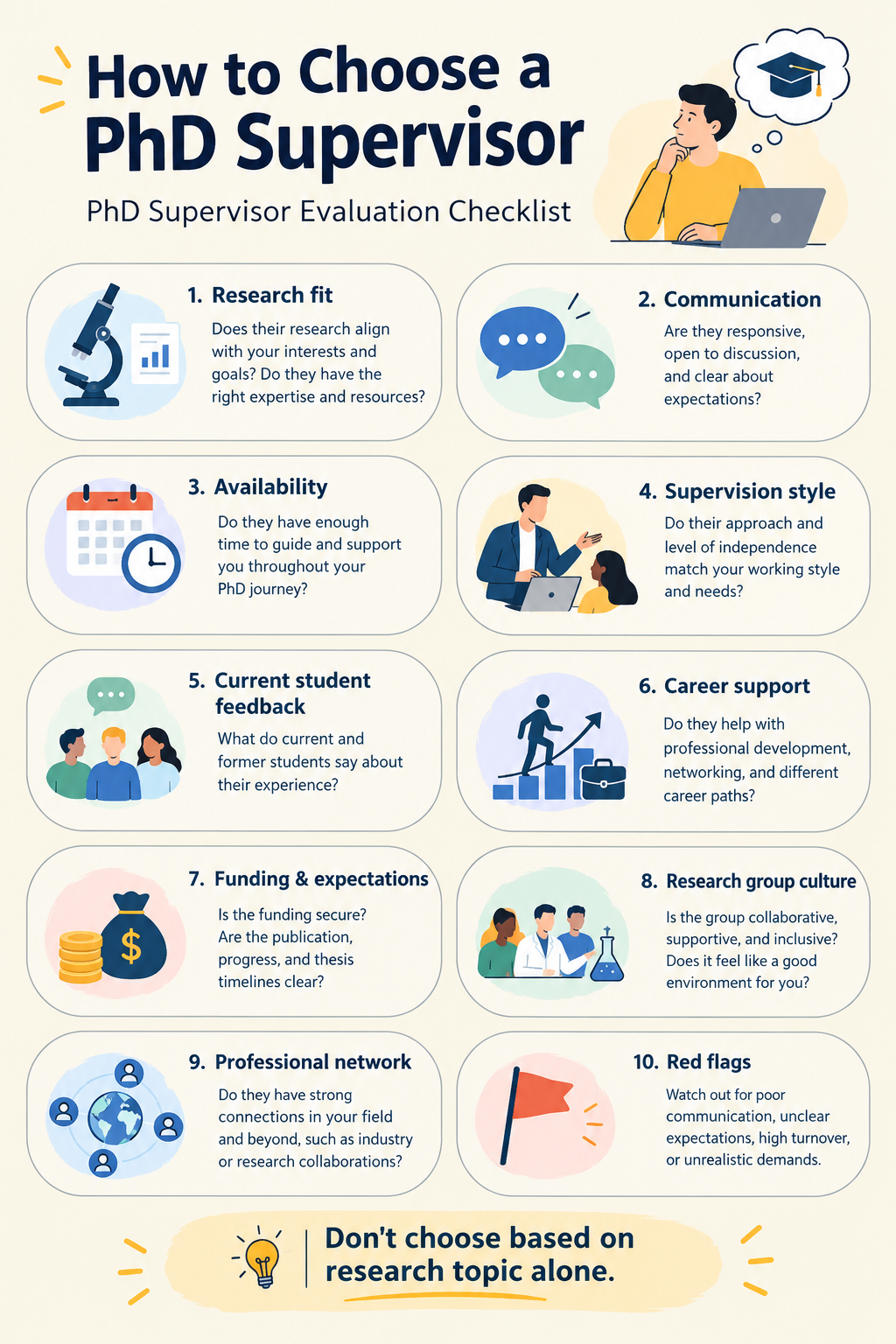
How to Choose a PhD Supervisor: A Guide for Prospective Researchers
Login
Sign upSign up for free
·9 min read
How to Choose a PhD Supervisor: A Guide for Prospective Researchers
Learn how to choose the right PhD supervisor by evaluating research alignment, working style, communication, availability, and current student feedback.
Choosing a PhD supervisor is one of the most important decisions you will make before starting your doctorate. Your research topic matters, but so does the person who will guide you through the years of reading, experimentation, writing, revisions, setbacks, and—eventually—your dissertation.
A good supervisor can help you become a more independent researcher, provide useful feedback, open professional doors, and give you room to develop your own ideas. A poor fit, on the other hand, can turn an otherwise promising PhD into a frustrating experience.
The tricky part is that a supervisor's profile rarely tells you everything you need to know. A strong publication record does not necessarily mean someone is an attentive mentor. A famous researcher may have limited time for individual students. And a supervisor who is perfect for one student may be completely wrong for another.
So, how do you choose?
The answer is to evaluate the supervisor ascarefully as they evaluate you.
What to Look for in a PhD Supervisor
There is no single checklist that guarantees you will find the right supervisor. Instead, look at several aspects of the relationship and consider how well they match your goals, working style, and expectations.
1. Check Their Research Fit
Start with the obvious question: does the supervisor's research actually align with what you want to study?
Read several of their recent publications rather than relying only on the description on a university profile. Look at the questions they investigate, the methods they use, and the direction their research appears to be taking.
You do not necessarily need an exact match. Research interests can evolve, and a supervisor may be open to exploring a new question. What matters is whether they have enough expertise, interest, and resources to support the kind of research you want to pursue.
Also consider the practical side of the research. If a project involves extensive programming, fieldwork, laboratory experiments, or statistical analysis, make sure you are comfortable with the day-to-day work involved—not just the broad topic.
If you are comparing several researchers, tools such as Author Mapping can also help you explore researchers and their publication connections more systematically.
2. Understand Their Supervision Style
Supervisors differ considerably in how they work with doctoral students.
Some meet their students every week, provide detailed feedback, and closely monitor progress. Others expect students to work independently and step in mainly when guidance is needed.
Neither approach is automatically better.
Ask yourself how you work best. Do you need regular structure and accountability? Or do you prefer considerable freedom to decide what to investigate and how to approach it?
Then find out whether the supervisor's approach matches yours.
During an interview, ask questions such as:
How often do you normally meet with PhD students?
How do you provide feedback on drafts?
How much independence do students typically have?
How do you help students when they get stuck?
How do you monitor progress toward milestones?
Avoiding a major mismatch in expectations, especially early on in your process, is critical. You can learn more about leadership styles from Keiser University.
3. Look at Their Availability
A highly accomplished supervisor who is rarely available may not be the best choice for you.
Professors can have teaching responsibilities, administrative roles, research projects, grant commitments, conferences, and large research groups. Their workload can affect how much time they can realistically dedicate to individual students.
Look beyond their job title! Ask about their current supervisory load.
You can also ask current students how frequently they interact with the supervisor and how long feedback usually takes. Someone saying, "My supervisor is busy but always makes time when it matters," tells you something very different from, "I sometimes wait months to hear back."
A healthy arrangement usually involves clear expectations about communication and reasonable turnaround times.
4. Talk to Current and Former Students
This may be one of the most useful steps in the entire process.
A prospective supervisor naturally has an incentive to present their research group positively. Current and former students can give you a different perspective on what working there is actually like.
If possible, speak privately with several students rather than relying on one conversation.
Ask specific questions:
How often do you meet your supervisor?
How quickly do they usually respond?
What happens when you disagree about your research?
How much freedom do students have?
How is feedback delivered?
What happens when a student makes a mistake?
Are students encouraged to attend conferences and training?
How would you describe the group culture?
What is one thing you wish you had known before joining?
Former students can be especially useful because they can tell you what happened after the PhD. Look at where previous students ended up, what kinds of roles they moved into, and whether the supervisor supported different career paths.
One enthusiastic student is encouraging. Consistent feedback from several people is much more informative.
5. Discuss Expectations Before You Join
Many problems between supervisors and students begin with assumptions that were never discussed.
You may assume that your supervisor will provide detailed feedback every week. They may assume you will work independently for months at a time. You may expect to publish several papers. They may prioritize completing a thesis over maximizing your publication count.
Talk about these expectations before accepting the position.
Financial arrangements should also be clear. Understand the stipend or salary, funding period, project funding, and what happens if your research takes longer than expected.
These conversations may feel awkward before you have even started the PhD. That is precisely why they are useful. A slightly uncomfortable conversation now can prevent a much bigger problem later.
Evaluate the Supervisor's Mentoring and Career Support
A PhD is not simply a long research project. It is also professional training.
Your supervisor can influence the skills you develop, the collaborations you encounter, the conferences you attend, and the professional network you build.
Ask what opportunities their students typically receive.
Career support is particularly important if you already know that you do not want to become a professor.
A good supervisor should be able to discuss your career goals without assuming that every student wants the same path.
It can also be useful to investigate a researcher's broader professional network. If you are considering several potential supervisors, Researcher Profile Creator can help you organize information about researchers and their professional backgrounds as part of your evaluation.
Consider the Research Group, Not Just the Supervisor
You are not only joining a relationship with one person. You are joining a research environment.
Consider the size and structure of the group. A large lab may provide access to many researchers, collaborators, and technical skills, but the supervisor may have less time for each student. A smaller group may offer more direct interaction but fewer peers to learn from.
Look at the group's atmosphere, too.
Do students collaborate or mostly work independently? Are junior researchers included in discussions? How are responsibilities distributed? Do people appear comfortable approaching the supervisor?
If possible, visit the lab or department before making a decision. Sometimes ten minutes of observing how people interact tells you more than an impressive university webpage.
Watch for Red Flags
No supervisor will be perfect. Everyone has busy periods, communication quirks, and occasional disagreements with students.
Still, some patterns deserve serious attention.
Limited access to the supervisor
If you struggle to get a meaningful conversation with a potential supervisor before joining, consider whether that pattern is likely to continue.
Vague answers about expectations
Be cautious if questions about working hours, publications, funding, or supervision are repeatedly avoided.
Consistently unhappy students
One dissatisfied student does not necessarily indicate a problem. Several students independently describing the same issue is much harder to ignore.
Unrealistic working expectations
Regular expectations to work excessive hours, be available outside reasonable working times, or sacrifice personal commitments should prompt careful consideration.
No support for your career goals
A supervisor who dismisses your career plans because they differ from their own may not be the right mentor for you.
High student turnover
Frequent departures, unfinished PhDs, or a pattern of students leaving the group can be worth investigating. There may be perfectly reasonable explanations, but you should know what they are.
Lack of clarity around authorship
Ask how authorship decisions are made and what contribution is expected for students to become authors. Unclear or inconsistent practices can create problems later.
A red flag does not always mean "immediately reject this supervisor." Context matters. But it does mean you should investigate further rather than explaining the warning sign away.
Prepare Questions for Your Potential Supervisor
Treat the interview as a two-way conversation.
You are trying to determine whether the supervisor is a good fit for you, not simply trying to convince them to accept you.
Here are some useful questions to take into an interview:
What are the publication and authorship expectations?
Pay attention not only to the answers but also to how the supervisor reacts to the questions. A thoughtful answer is useful information. So is defensiveness, vagueness, or irritation.
Compare Supervisors Before Making a Decision
If you have more than one potential supervisor, avoid making the decision based solely on prestige, university ranking, or the attractiveness of a research topic.
Create a simple comparison covering factors such as:
Factor
Supervisor A
Supervisor B
Research fit
Availability
Supervision style
Lab/group culture
Career support
Publication expectations
Funding
Student feedback
Professional network
Overall fit
You can also assign greater weight to the factors that matter most to you.
For example, if you want a highly independent PhD, supervision style might matter more than the supervisor's publication count. If you want an academic career, mentoring and research-network opportunities may carry more weight.
There is no universal scoring system. The point is to make your reasoning visible instead of letting one impressive feature dominate the decision.
The Best PhD Supervisor Is the Right Fit for You
Choosing a PhD supervisor is ultimately a matching exercise.
The researcher with the biggest publication record is not automatically the best supervisor. Nor is the most senior professor, the most prestigious university, or the person working on the most exciting topic.
Look for someone whose research interests you, whose expectations are compatible with yours, and whose supervision style fits how you work. Investigate their availability, mentoring approach, research group, career support, and track record with students. Most importantly, talk to people who have actually worked with them.
And do not ignore your own priorities!
Your PhD will probably involve difficult experiments, rejected papers, confusing results, and at least a few days when you wonder why you chose this path at all. In these stormy times, having a supervisor who communicates clearly and supports your development can make those challenges much easier to navigate.
The goal is not to find a perfect supervisor. It is to find a supervisor and research environment where you can do good work, develop as a researcher, and finish your PhD without compromising the things that matter to you.