10 Citation Generators for Researchers (2026): Features and Limits
Login
Sign upSign up for free
22 Nov 2023··8 min read
AI Citation Generators: 10 Tools for Researchers in 2026
In this article, we will explore the benefits and limitations of AI citation generators, as well as the best AI citation generators that ease the process of citation generation.
In the realm of academic writing, accurate and consistent referencing is an essential component of upholding credibility and avoid plagiarism. AI citation generators, powered by natural language processing and machine learning algorithms, have emerged as transformative tools, streamlining the process of creating citations in various styles.
In this article, we will explore the benefits and limitations of AI citation generators, as well as the best AI citation generators that ease the process of citation generation.
An AI citation generator is a tool that utilizes artificial intelligence algorithms to automatically generate citations for various types of sources, such as books, journal articles, websites, and more. These generators aim to simplify the citation process by automatically formatting and organizing the necessary information required for proper citation.
When using an AI citation generator, researchers can simply input the relevant details of their sources, such as the author's name, publication date, title, and URL, if applicable. The generator then uses its AI algorithms to analyze the input and generate a properly formatted citation in the desired citation style.
What is the role of AI in citation generation?
AI and automation can reduce the amount of manual work involved in creating references. A citation tool may identify information such as an author's name, publication date, article title, journal, DOI, or URL and then arrange those details according to a selected citation style.
What are the key features of AI citation generators?
AI citation generators are equipped with several useful features that enhance the citation generation process and save valuable time for researchers and students. Let's take a closer look at some of these features:
Automatic formatting of citations: One of the most significant advantages of AI citation generators is their ability to automatically format citations according to different citation styles. Whether you need an APA citation for a journal article or a Chicago citation for a book, these generators can handle it all.
Integration with reference management software: Many AI citation generators offer seamless integration with popular reference management software. This integration allows users to easily import and organize citations within their preferred reference management system.
Wide range of source types: AI citation generators can generate citations for various source types, including books, journal articles, websites, conference papers, and more. This versatility makes them suitable for researchers and students across different disciplines.
Style coverage: Check whether a tool supports the edition or journal style you need, and compare the output with the current official style guidance.
With their advanced algorithms, comprehensive databases of citation styles, and user-friendly features, AI citation generators have become invaluable tools for researchers and students alike. They can simplify the citation process, but automated references still need manual checking.
What are 10 citation generators researchers can use?
These tools are listed for their active citation or reference workflows, coverage of common academic styles, and usefulness to researchers; their order is not a quality ranking. Check every generated reference against the original source and your required style guide.
1. SciSpace Citation Generator
SciSpace APA Citation Generator
SciSpace Citation Generator is a citation generator and a comprehensive citation tool specifically designed for scientific research. It seamlessly handles a wide range of source types, including journal articles, books, websites, and conference proceedings. It can help identify citation elements and generate citations in more than 2,300 styles, including APA, MLA, Chicago, and Harvard. The tool is completely free to use and has an intuitive, ad-free interface.
You can also play around with SciSpace ChatPDF to smoothen your research paper analysis.
2. Bibliography.com
Bibliography.com
Bibliography.com is a browser-based citation and bibliography generator focused on common academic styles such as MLA, APA, and Chicago. It lets users search for sources using information such as a book title, author, ISBN, or URL.
It also provides tools for creating in-text citations and organizing references for a project.
Best for: Students who need a straightforward generator for common citation styles.
3. Quetext Citation Generator
Quetext Citation Generator
Quetext Citation Generator creates citations in APA, MLA, and Chicago styles. You can enter a webpage URL or source information, review the retrieved metadata, and edit missing or incorrect fields before generating the citation.
Its citation generator is also part of a broader writing and plagiarism-checking workflow.
Best for: Students who want citation generation alongside plagiarism-checking tools.
4. EduBirdie Citation Generator
EduBirdie Citation Generator
EduBirdie Citation Generator supports 16 citation styles, including APA, MLA, Chicago, IEEE, AMA, Turabian, Harvard, CSE, ACS, Vancouver, NLM, and ACM. It supports both automatic and manual citation creation and lets users edit generated references.
Best for: Students who need several common academic and scientific citation styles in one tool.
5. ZoteroBib
ZoteroBib is a free, browser-based bibliography generator from the team behind Zotero. You can add a source using a URL, DOI, ISBN, PMID, arXiv ID, or title, then generate a bibliography in the style you need.
ZoteroBib supports more than 10,000 citation styles and can also create in-text citations and footnotes. For larger research projects, the full Zotero reference manager provides more extensive organization and library-management features.
Best for: Quickly creating a bibliography without installing reference-management software.
6. Scribbr Citation Generator
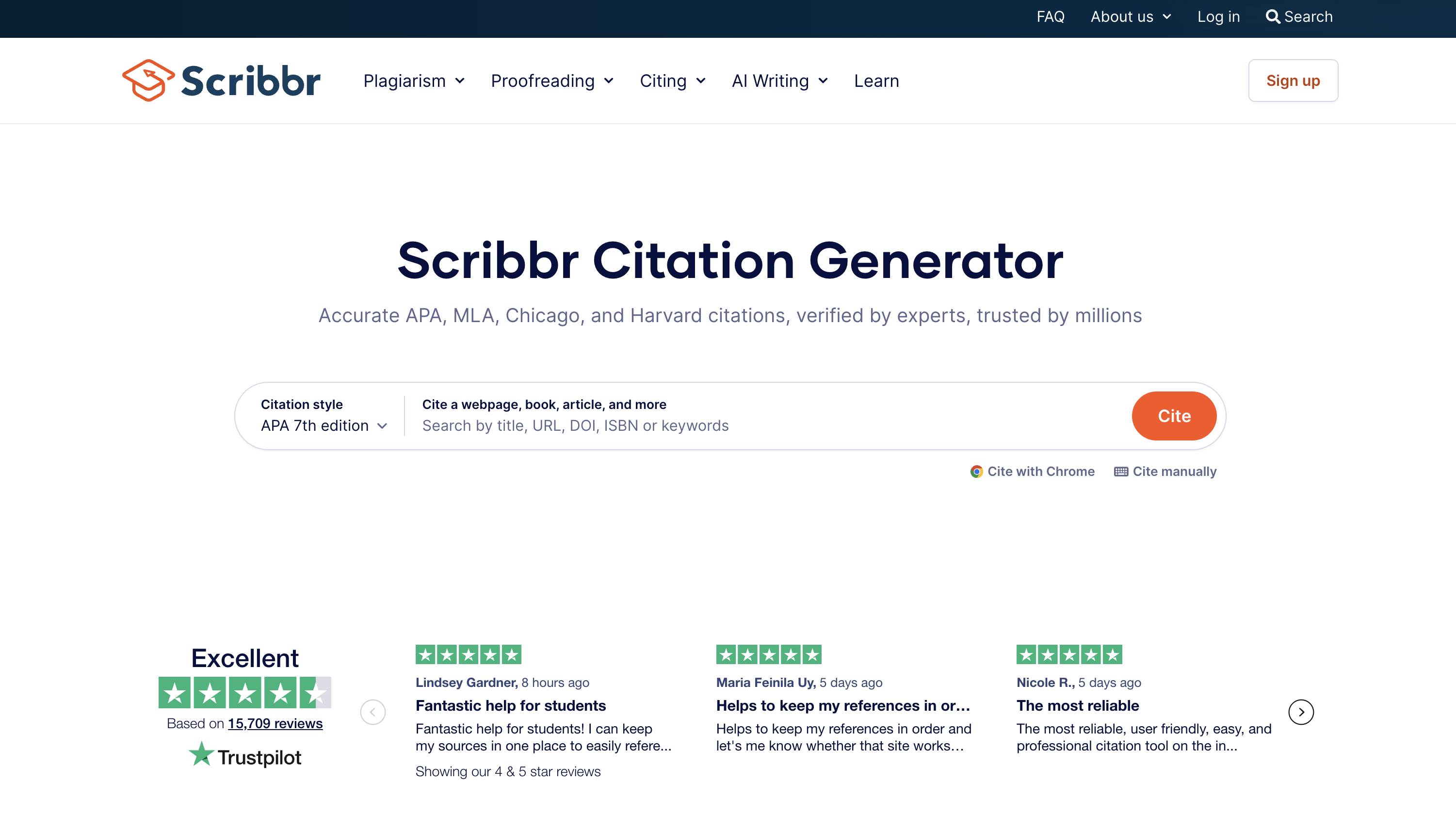
Scribbr Citation Generator creates citations for webpages, books, articles, and other sources. It supports APA, MLA, Chicago, Harvard, and other citation rules and can search for sources using a title, URL, DOI, ISBN, or keywords.
Scribbr also lets users edit references and export completed reference lists to Word.
Best for: Students who want citation generation with academic writing and formatting resources.
7. MyBib
MyBib is a free citation and bibliography generator that supports APA, MLA, Chicago, Harvard, and other styles. It can find sources using information such as a title, URL, or ISBN and automatically format the resulting references.
MyBib currently advertises more than 9,000 citation styles and supports exports to formats such as Microsoft Word and Google Docs.
Best for: Students looking for a free bibliography generator with broad style coverage.
8. QuillBot Citation Generator
QuillBot Citation Generator lets users create citations by searching with a title, URL, DOI, ISBN, or keywords. It supports more than 1,000 citation styles, including APA, MLA, Chicago, and Harvard.
Users can also upload a PDF or enter citation information manually and organize references into a bibliography.
Best for: Students who already use QuillBot's other academic writing tools.
9. BibGuru
BibGuru is a citation and bibliography generator that supports APA, MLA, Harvard, Chicago, AMA, CSE, and many other styles. Users can search for books, websites, and journal articles and add them to a bibliography.
It also provides citation guides for specific source types and styles.
Best for: Students who want a simple way to build and organize a bibliography.
10. Zotero
Zotero is a reference manager rather than a simple citation generator. It lets researchers collect, organize, and manage sources, then create citations and bibliographies from items saved in their library.
Zotero can generate bibliographies in different citation styles and export references in formats such as BibTeX and RIS, making it useful for longer research projects and manuscripts.
Best for: Researchers managing large reference libraries or working on long-term projects.
What are the benefits of AI citation generators
Efficiency and Speed: AI citation generators eliminate the need for manual citation formatting, saving researchers valuable time and effort. They can quickly analyze source information and generate citations in the desired style, allowing users to focus on the substance of their writing.
Accuracy and Consistency: AI citation generators are trained on vast datasets of academic and creative works, ensuring that the generated citations adhere to the nuances of various citation styles, such as APA, MLA, Chicago, and Harvard. This reduces the risk of errors and inconsistencies, maintaining the integrity of the referencing process.
Accessibility and Versatility: AI citation generators are typically accessible online, providing a convenient platform for users to generate citations from anywhere. They can handle a wide range of source types, including journal articles, books, websites, and conference proceedings, making them adaptable to diverse writing projects.
What are the limitations of AI citation generators
Over-reliance and Critical Thinking
While AI citation generators offer convenience, it's crucial to exercise critical thinking when using these tools. Over-reliance can lead to an oversimplification of the referencing process, potentially overlooking important details or nuances of specific citation styles.
Errors and Misinterpretations
Despite their sophistication, AI citation generators are not immune to errors or misinterpretations. Complex or unusual source types may not be accurately analyzed, and the generated citations may not capture all relevant information.
Understanding Citation Styles
AI citation generators can provide accurate citations, but they may not impart a deep understanding of citation styles. Users should still familiarize themselves with the underlying principles of each style to ensure proper referencing and avoid potential plagiarism.
How to check an AI-generated citation
Before adding a generated citation to your paper, check:
Author names: Are they spelled correctly and listed in the correct order?
Publication date: Does it match the original source?
Title: Is the title complete and correctly capitalized?
Journal or book information: Check the journal title, volume, issue, edition, and page range where applicable.
DOI or URL: Make sure the identifier points to the correct source.
Citation style: Confirm that the output follows the required edition of APA, MLA, Chicago, IEEE, or another style.
Source relevance: Make sure the source actually supports the statement you're citing.
For larger reference lists, tools such as the SciSpace Citation Formatter Agent can help format and validate references across styles, while the Citation Audit Agent can help identify unsupported claims and add references to a draft.
Conclusion!
While AI citation generators have undoubtedly simplified the process of creating citations, it is important to be aware of their limitations. By exercising caution, engaging in manual review and editing, and fostering collaboration, researchers can ensure the accuracy and reliability of citations generated by AI tools. With continued advancements and improvements, AI citation generators have the potential to become even more robust and dependable in the future.